
What Are the Different Types of Saw Blades: Practical Workshop Guide for 2026
Learn what are the different types of saw blades to make clean, accurate cuts across wood, metal, and tile in this November 2026 guide.
 By Bradley Ford
Updated November 5, 2026
Pushing a dense piece of oak through a spinning blade only to see dark scorch marks and smoke rising from the kerf is a frustrating reality for many woodworkers. Achieving clean, square cuts without dangerous kickback or costly veneer tear-out begins with matching the right tooling to your specific material. Understanding what are the different types of saw blades transforms how your power tools perform, whether you operate a portable jobsite table saw or a handheld cutting tool. Selecting the correct plate thickness, gullet clearance, and tooth grind geometry protects your motor from thermal strain while keeping your cuts accurate.
From aggressive ripping profiles that plow through framing lumber to high-count finish blades designed for cabinet veneers, every blade configuration serves a distinct mechanical role. Beginners and seasoned remodelers often struggle with blade deflection, bogging motors, and mismatched arbor bores when switching between substrates. Equipping a dedicated compact circular saw selection with the proper consumable ensures smooth passes across nominal dimensional lumber, sheet goods, and non-ferrous metals. Recognizing how tooth design, kerf thickness, and material composition interact helps you avoid kickback hazards and achieve dependable edge quality on every pass.
| Award | Product | TGH Score About TGH ScoreThe TGH Score is our own rating from 0 to 10, based on performance, design and build, ease of use, and value. It reflects independent research and is never influenced by manufacturers, retailers, or affiliate commissions. Learn more › | |
|---|---|---|---|
| Best Overall |
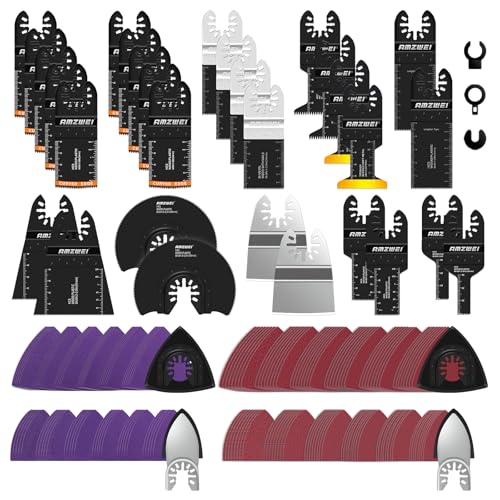
AMZWEI 190-Piece Oscillating Tool Blade Set
|
9.2/10 | Buy |
| Best Value |
 Zericuf 85mm Mini Table Saw Blades (4-Pack) |
8.8/10 | Buy |
AMZWEI 190-Piece Oscillating Tool Blade Set
Geared toward extensive home repairs and workshop projects, this 190-piece accessory set pairs multi-material cutting blades with durable zirconia sanding sheets. The curved-edge blade profile helps reduce operating vibration across various oscillating multitool brands.
Pros
- Broad assortment handles both cutting and detailed sanding tasks
- Zirconia sandpaper sheets offer enhanced abrasive durability
- Curved blade edges promote smoother cutting action
- Universal fit supports most major oscillating tool models
Cons
- Bulk of the piece count consists of sandpaper sheets
- Certain tool models may require checking specific adapter fit
Zericuf 85mm Mini Table Saw Blades (4-Pack)
Tailored specifically for Zericuf mini multifunctional table saws, this four-piece blade pack equips hobbyists with versatile options for delicate craft cutting. The assortment includes alloy, high-speed steel, diamond, and double mesh wheels to tackle diverse materials.
Pros
- Includes four blade styles for diverse craft materials
- Features alloy, diamond, HSS, and abrasive cutting discs
- Direct fit for Zericuf mini table saws
- Convenient replacement pack for frequent hobby cutting
Cons
- Only compatible with Zericuf mini table saws
- Restricted to small 80 to 85mm cutting depths
A Complete Breakdown of Saw Blade Types and Geometries
Saw blades vary across tooth geometry, plate thickness, diameter, and metallurgical composition to match the mechanical resistance of specific materials. Using an incorrect blade leads to severe friction burns, chipped surfaces, motor bogging, or violent rotational kickback. Matching your tool arbor and speed rating to the appropriate blade configuration ensures safer operations and cleaner cuts.
Circular and Table Saw Blades by Cutting Task
Rip blades cut parallel to the wood grain along the length of a board. These blades feature low tooth counts, often between 24 and 30 teeth on a standard 10-inch blade, paired with deep gullets. Because wood fibers act like small bundles of straws, ripping requires large spaces between teeth to clear long wood chips rapidly. Attempting to rip hardwoods with a high-tooth blade packs the gullets with sawdust, generating intense friction that scorches the workpiece and stalls the motor.
Crosscut blades slice across wood fibers at a 90-degree angle. These discs incorporate high tooth counts, typically ranging from 60 to 80 teeth on stationary saws, to shear fibers cleanly. The gullets on crosscut blades are much smaller because crosscutting produces fine, powdery sawdust rather than elongated shavings. Using a dedicated crosscut blade on pre-finished plywood or hardwood face frames yields crisp edges without severe splintering along the cut line.
Combination blades bridge the operational gap between fast ripping and clean crosscutting. A standard 50-tooth combination blade groups teeth in clusters of five, featuring four alternate top bevel teeth followed by one flat raker tooth and a deep gullet. This balanced profile allows carpenters to switch between ripping framing lumber and making crosscuts without taking time to swap blades. While combination discs may not match the glass-smooth finish of an 80-tooth blade, they deliver practical versatility for general remodeling.
Tooth Grind Geometries and Cutting Dynamics
Tooth grind geometry dictates how individual carbide tips contact the material and fracture its surface. Flat Top Grind teeth feature a squared-off profile across the top edge, functioning like miniature chisels that plane wood flat. This configuration excels at rapid ripping along natural grain lines, leaving a flat-bottomed kerf ideal for joinery grooving. Flat Top teeth are prone to tearing grain fibers when pushed across the grain, making them unsuitable for clean crosscutting tasks.
Alternate Top Bevel teeth alternate between left-hand and right-hand knife edges across the blade circumference. Each tooth shears the wood fiber on one side of the kerf, allowing the next tooth to sever the opposite edge with minimal tearing. High Alternate Top Bevel configurations increase the bevel angle beyond 30 degrees, providing razor-sharp slicing action across delicate wood veneers and brittle melamine laminates. The sharper points on high-bevel profiles wear faster in gritty composites, requiring frequent cleaning to maintain performance.
Triple Chip Grind profiles pair a flat raker tooth with a higher, trapezoidal tooth that cuts a center groove. The trailing flat tooth clears the corners of the kerf, distributing mechanical stress across both cutters evenly. This geometry resists impact damage when cutting dense plastics, solid surface materials, medium-density fiberboard, and non-ferrous metals like aluminum extrusions. Because carbide corners are chamfered on the trapezoidal teeth, the cutting edges resist chipping when contacting abrasive resins.
Hook angle defines the forward or backward lean of the teeth relative to an imaginary line drawn from the blade center. Positive hook angles pull the workpiece into the blade for fast cutting on table saws. Negative hook angles tilt the teeth backward between minus 5 and minus 10 degrees, creating a scraping cut that prevents the spinning blade from climbing over the material. Installing a negative hook blade on a sliding compound miter saw prevents the carriage from self-feeding aggressively toward the operator.
Kerf Thickness and Splitter Safety Alignment
Kerf width represents the overall thickness of the cut slot carved out by the carbide teeth. Full-kerf blades feature a 1/8-inch cutting width supported by a rigid steel plate that resists deflection under heavy feed pressure. These sturdy plates produce exceptionally flat cuts in thick hardwoods but require significant motor power to push through stock. Stationary cabinet saws equipped with three-horsepower induction motors handle full-kerf tooling easily, whereas lower-powered saws may struggle under the load.
Thin-kerf blades measure approximately 3/32 of an inch, reducing the amount of wood converted into sawdust by roughly one quarter. By removing less material per revolution, thin-kerf profiles drastically reduce drag on universal motors found on portable benchtop and jobsite saws. This reduced resistance helps prevent cordless saws from depleting battery packs prematurely during repetitive framing cuts. The primary trade-off involves plate rigidity, as thin plates can flex when forced through dense, twisted boards.
Riving knife alignment is one of the most critical safety checkpoints when matching blades to table saws. The riving knife must be thicker than the steel blade plate yet slightly thinner than the overall kerf carved by the carbide teeth. If the knife is thicker than the tooth kerf, the wood will bind against the splitter mid-cut, stalling the pass and tempting the operator to push dangerously hard. Conversely, an undersized knife allows cut stock to pinch the rear teeth of the spinning blade, launching the board toward the user in a violent kickback event.
Oscillating Multi-Tool Blades and Construction Materials
Oscillating multi-tools rely on rapid side-to-side micro-movements rather than high-speed continuous rotation to make controlled plunge cuts. Blade kits like the AMZWEI 190 Metal Wood Oscillating Tool Blade package illustrate how diverse tooth compositions serve specialized renovation challenges. High carbon steel blades flex slightly without snapping, making them ideal for plunge cuts in baseboards, drywall cutouts, and soft timber. Because soft steel teeth dull quickly against hard fasteners, pairing the right metal alloy to the substrate is essential.
Bi-metal and titanium-coated oscillating blades bond hardened high-speed steel teeth to flexible alloy backings to handle tough embedded hardware. The titanium coating helps dissipate surface friction, allowing the cutter to sever drywall screws, copper pipes, and finishing nails without stripping teeth immediately. Curved-edge profiles on oscillating blades offer another mechanical advantage by maintaining an optimal cutting angle throughout the oscillating arc. This curved contact patch reduces vibration against delicate trim work and facilitates smoother initial plunge engagement into hardwood floors.
Universal arbor interfaces allow multi-tool blades to mount securely across various tool platforms without slipping under load. Compatibility listings for brands like Milwaukee, Dewalt, Makita, Fein, and Bosch ensure that user accessories transfer between different shop tools. When selecting oscillating accessories, checking arbor pin patterns prevents dangerous wobble during high-frequency vibration. The versatility of multi-tool blades makes them indispensable for flush-cutting door jambs during flooring installations where standard circular saws cannot reach.
Mini Table Saw and Craft Blades for Fine Joinery
Small-scale modeling and precision hobby cutting require specialized tooling far smaller than standard construction blades. The Replacement Saw Blades for Zericuf Mini Table set highlights how compact 80 to 85 millimeter blades adapt small hobby table saws to diverse materials. These miniature discs utilize a 16 millimeter aperture bore to mount securely on compact motor spindles, operating at high rotational speeds to deliver fine cut lines. Using large construction blades on delicate craft stock would tear thin veneers and splinter fragile modeling woods.
Craft blade kits often bundle four distinct cutter types to address varied hobby substrates within compact workshops. Tungsten alloy blades deliver clean sawing action through thin craft hardwoods, balsa, and hobby plywood without blowing out rear edges. High-speed steel discs feature fine, closely spaced teeth designed to slice cleanly through model plastics, acrylics, and thin aluminum hobby sheets. Meanwhile, diamond continuous rim blades allow crafters to grind through miniature ceramic tiles, sea glass, and lapidary specimens smoothly using light water lubrication.
Abrasive double mesh wheels round out the craft cutting arsenal by cutting through hardened steel wire, small brass rods, and structural hobby tubes. These resin-bonded wheels grind material away rather than slicing it, eliminating the risk of tooth catching on thin-walled metal tubing. For craft enthusiasts, having rapid access to interchangeable discs ensures that delicate model parts remain intact during cutting. Secure mounting and proper arbor hole sizing prevent blade wobble, which can quickly ruin fragile miniature projects.
Reciprocating and Jigsaw Blades for Demolition and Curved Cuts
Demolition projects and structural remodel work demand durable blades capable of surviving heavy impacts and flexing without snapping. Contractors routinely rely on rugged reciprocating saw blades for demolition to slice through framing studs loaded with hardened drywall screws, framing nails, and galvanized steel pipe. Reciprocating blades feature variable tooth counts, utilizing coarse 6-TPI configurations for rapid rough lumber cutting and dense 14 to 24-TPI layouts for cutting conduit and structural angle iron. Thick blade profiles resist bending during aggressive push-pull strokes inside wall cavities.
Jigsaws specialize in cutting tight curves, sink cutouts, and intricate internal profiles that circular saws cannot navigate. Modern jigsaw blades use T-shank mountings that lock firmly into tool-free quick-release blade clamps without requiring set screws. Standard blades feature upward-pointing teeth that cut on the upstroke, which pulls the saw shoe tightly against the stock but can splinter the top face of plywood. Down-cutting blades reverse this tooth orientation to cut on the downstroke, preserving delicate decorative laminate countertops at the cost of requiring firmer downward grip pressure from the operator.
Continuous Band Saw and Fine Scroll Saw Blades
Band saws utilize a continuous, flexible steel loop operating over two or three balanced wheels to deliver uninterrupted downward cutting force. Tooth pitch and blade width dictate whether a band saw excels at tight radius scrolling or wide timber resawing. Narrow 1/8-inch blades navigate sharp curves in decorative craft pieces, while wide 3/4-inch or 1-inch blades resist lateral deflection when slicing thin veneer leaves from thick hardwood blocks. Regular tooth geometries handle general cutting, while hook teeth with large gullets provide aggressive chip evacuation during heavy resaw operations.
Stationary scroll saws operate at the opposite end of the spectrum, using delicate reciprocating hair-thin blades for intricate fretwork and wooden puzzle making. Consulting a dedicated scroll saw workshop guide helps clarify how pinned and plain-end blades behave across thin hardwoods and craft veneers. Plain-end blades slip through tiny pilot holes in the workpiece for pierce-work, while reverse-tooth blades incorporate downward-facing lower teeth to prevent splintering on the underside of the wood. Spiral scroll saw blades feature cutting teeth facing in all directions, permitting omnidirectional movement without turning the workpiece.
Diamond and Abrasive Cut-Off Blades for Masonry and Metal
Masonry, natural stone, and ceramic tile cutting require diamond blades that grind material away rather than slicing it with sharp carbide teeth. These blades feature a circular steel core with industrial diamond grit bonded to the rim via sintered metal matrices. Continuous rim diamond blades provide chip-free cutting edges on delicate porcelain and ceramic tiles, requiring continuous water cooling to prevent core warping. Segmented rim blades feature cooling gullets between diamond sections, permitting dry cutting through concrete pavers, cinder blocks, and brick where dust evacuation is vital.
Abrasive cut-off wheels utilize aluminum oxide or silicon carbide grains bound with resin and fiberglass mesh to sever heavy structural metals. Found on chop saws and handheld cut-off tools, these consumable discs wear down in diameter progressively as they grind through rebar and steel tubing. Because abrasive discs generate extreme friction and hot sparks, matching the wheel maximum rated RPM to the power tool spindle speed is an essential safety precaution. Exceeding the rated speed of an abrasive disc can cause catastrophic wheel disintegration under load.
Practical Blade Maintenance and Safety Protocols
Pitch and resin accumulation on carbide teeth dramatically accelerates friction, turning clean cutting actions into scorching struggles. Cleaning dirty blades with a citrus-based solvent or specialized resin stripper dissolves sticky sap, restoring clearance angles without dulling the sharp carbide edges. Operators should inspect teeth regularly for chipped corners, missing carbide tips, or hairline cracks along the steel expansion slots. Operating a blade with missing teeth increases vibration and throws unbalanced forces into the saw motor bearings.
Safe tool operation demands strict adherence to power isolation protocols whenever handling sharp cutting tooling. Disconnect the power cord or remove the lithium-ion battery pack before loosening the arbor bolt or adjusting the riving knife. Always use properly sized arbor wrenches rather than adjustable pliers to avoid rounding the spindle nut corners. Once installed, verify that the blade spins freely without contacting guards, throat plates, or splitters before engaging power to make test passes on scrap stock.
About the author

Bradley Ford is an experienced hands-on tool tester with a background in farm equipment, welding, mechanical repair, and classic automobiles. His practical experience includes repairing and servicing high-end vehicles as well as testing tools, generators, lawn equipment, and workshop gear. He approaches product evaluation from the perspective of someone who regularly builds, repairs, and maintains equipment.