
How Does a Portable Band Saw Work: Mechanics and Operation for 2026
Learn how does a portable band saw work through continuous blade loops, gear reduction, and guide rollers for clean metal cutting in November 2026.
 By Bradley Ford
Updated October 13, 2026

Cutting metal on a jobsite frequently generates dangerous sparks, high heat, and ragged edges when workers use abrasive cutoff wheels or reciprocating saws. Handheld metal-cutting tools resolve these hazards by looping a narrow, flexible blade continuously around two compact internal wheels to deliver rapid, spark-free cuts through conduit, pipe, and steel bar stock. Understanding how does a portable band saw work helps tradespeople, fabricators, and DIY builders achieve clean, square cutoffs without damaging heat-sensitive materials. A quick look at what bandsaws are used for across workshops highlights how continuous unidirectional blade motion provides superior control over traditional back-and-forth sawing methods.
A portable bandsaw, commonly called a portaband, relies on an electric motor paired with a heavy-duty reduction gearbox to drive a looped bi-metal blade across a compact open throat. Dual sets of ball-bearing guide rollers twist and stabilize the band as it enters the cutting area, keeping the thin kerf straight even under continuous hand pressure. Today’s tools span from lightweight twelve-volt cordless units designed for overhead electrical conduit cuts to deep-cut corded tools boasting ten-amp motors capable of slicing through five-inch structural stock. Learning the mechanical relationship between motor speed, blade tension, and roller guides ensures cleaner cuts and extends tool life.
| Award | Product | TGH Score About TGH ScoreThe TGH Score is our own rating from 0 to 10, based on performance, design and build, ease of use, and value. It reflects independent research and is never influenced by manufacturers, retailers, or affiliate commissions. Learn more › | |
|---|---|---|---|
| Best Overall |
PowerSmart 10A Portable Band Saw with Removable
|
8.8/10 | Buy |
| Best Value |
 Milwaukee M12 FUEL Compact Cordless Band Saw |
8.6/10 | Buy |
| Best Budget |
 WEN BA3959 9-Inch Benchtop Band Saw with 2.8-Amp |
8.4/10 | Buy |
 VEVOR 10-Amp Deep Cut Portable Band Saw |
8.4/10 | Buy | |
| Best Premium |
 Milwaukee M18 Compact Brushless Band Saw |
8.4/10 | Buy |
 DEWALT 20V MAX XR Brushless Cordless |
8.4/10 | Buy | |
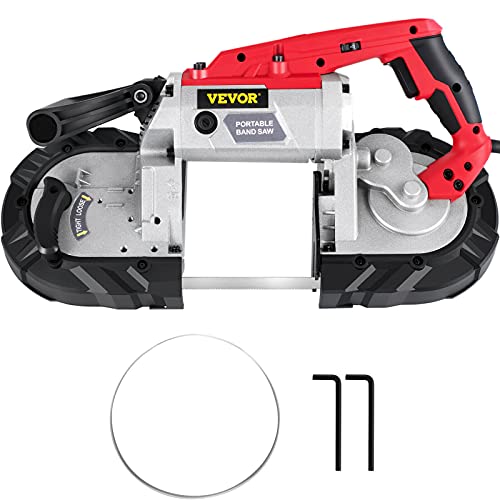 VEVOR 10-Amp Deep Cut Portable Band Saw |
8.3/10 | Buy | |
 Ecarke 2-1/2-Inch Cordless Band Saw |
8.3/10 | Buy | |
 Ecarke 2-1/2-Inch 20V Cordless Band Saw |
8.0/10 | Buy | |
 MAXXT 10A 5-Inch Deep Cut Portable Band Saw |
8.0/10 | Buy |
PowerSmart 10A Portable Band Saw with Removable
The PowerSmart 10A Portable Band Saw delivers a generous 5-by-5-inch cutting capacity and a removable 0-45 degree alloy steel miter base for versatile handheld and benchtop metal slicing. It is an excellent, cost-effective cutting solution for metal fabricators, electricians, plumbers, and DIYers wanting spark-free cuts on pipe, strut, and bar stock.
Pros
- Generous 5-inch cutting capacity clears larger pipe and structural profiles than typical compact handheld bandsaws
- Removable alloy steel miter base provides stationary benchtop chop-cutting versatility right out of the box
- Six-speed electronic control (0 to 435 FPM) allows precise speed tuning for carbon steel, conduit, or aluminum
- Includes two 44-7/8-inch 14 TPI blades, dual-bearing blade guides, and an integrated LED work light
Cons
- Weighs approximately 30 pounds with the steel base attached, requiring two hands or dedicated workbench space for stationary use
- Factory 14 TPI blades are general-purpose starters that may struggle on very thin sheet metal or dense solid billets without upgrading
- Miter base angle scale benefits from manual checking with an engineer square to ensure dead-square 90-degree alignment
Milwaukee M12 FUEL Compact Cordless Band Saw
The Milwaukee M12 FUEL Compact Band Saw delivers a 2.5-inch cutting capacity and up to 570 FPM in a portable 6.0-pound frame. It is a reliable choice for electricians, plumbers, and fabricators seeking clean, spark-free metal cuts in confined spaces.
Pros
- Lightweight 6.0-pound design significantly minimizes arm strain during overhead or one-handed cuts
- Generous 2.5-inch throat capacity accommodates standard conduit, pipe, and unistrut stock
- Built-in work light provides clear cut-line visibility in poorly illuminated utility spaces
- Durable reinforced nylon chassis paired with a 5-year warranty ensures dependable commercial longevity
Cons
- Sold as a bare tool without an M12 battery pack or charger included
- 2.5-inch throat clearance cannot handle larger structural pipes or bar stock exceeding 2-1/2 inches
- Factory specifications list no lock-on switch, requiring constant manual trigger pressure during cuts
WEN BA3959 9-Inch Benchtop Band Saw with 2.8-Amp
The WEN BA3959 9-Inch Benchtop Band Saw combines a 2.8-amp motor with a 3-1/2-inch cutting depth and ball-bearing blade guides for detailed curve cuts and light resawing. It offers dependable utility for hobbyists, DIYers, and small craft workshops wanting versatile cutting in a compact footprint.
Pros
- Compact 40-pound benchtop footprint easily fits into home garages and small craft shops
- Ball-bearing blade guides help support blade stability during curved and straight cuts
- Includes a rip fence, miter gauge, and a 1/4-inch blade right out of the box
- Integrated 2-1/2-inch dust port connects easily to standard workshop vacuums
Cons
- 3-1/2-inch maximum cut depth restricts resawing to smaller dimensional lumber and craft stock
- 2.8-amp motor requires a steady, conservative feed rate to avoid bogging in dense hardwoods
- Fence and miter gauge require manual verification with a square prior to precise cuts
VEVOR 10-Amp Deep Cut Portable Band Saw
Driven by an 1100W 10-amp motor and paired with a removable alloy steel base, this VEVOR portable band saw delivers up to 5 inches of cutting capacity for handheld or benchtop metal fabrication. It offers a practical, spark-free cutting solution for electricians, plumbers, and metalworkers cutting conduit, tubing, and angle iron.
Pros
- Versatile dual-mode design transitions quickly between handheld jobsite work and stationary benchtop cutting
- Deep 5-inch round stock cutting clearance handles thick structural tubing, pipe, and unistrut
- Wide variable speed range (137.8-472.4 ft/min) optimizes cutting across varied metals and plastics
- Included alloy steel base provides an integrated 0-45 degree miter clamp for consistent angle cuts
- Virtually spark-free cutting operation significantly reduces hot debris in enclosed workspaces
Cons
- Total assembly weight of 28.7 pounds can make extended overhead freehand cutting fatiguing
- Mounting the saw to the benchtop base reduces maximum cutting capacity to 3.93 inches
- Corded 110V power source requires an extension cord or accessible AC outlet on the jobsite
Milwaukee M18 Compact Brushless Band Saw
Equipped with a POWERSTATE brushless motor and Constant Power Technology, this compact Milwaukee band saw delivers fast cutting speeds while trimming tool weight to 7.67 pounds. It is an excellent choice for electricians, plumbers, and remodelers needing quick, portable cuts in tight jobsite quarters.
Pros
- Over 20 percent lighter than the original M18 compact band saw at just 7.67 pounds
- Brushless motor paired with Constant Power Technology prevents heavy bogging during tough cuts
- Compact overall dimensions make overhead cutting and tight-space maneuvering much easier
- Reduces sparks, debris, and ragged edges compared to traditional abrasive cutting tools
Cons
- Sold as a bare tool without batteries, a charger, or a hard carrying case included in the base listing
- Compact throat profile has lower clearance than full-size deep-cut band saws when tackling larger structural beams
- Listing does not detail included band saw blade tooth specifications, requiring users to supply application-specific blades
DEWALT 20V MAX XR Brushless Cordless
The DEWALT DCS378B is a 20V MAX XR cordless portable bandsaw featuring a brushless motor that delivers 535 MWO and a 3-3/8-inch cut capacity. It is a capable, spark-free cutting solution for commercial electricians, plumbers, and mechanical contractors cutting strut, pipe, and conduit.
Pros
- Brushless motor delivers 535 MWO at 570 SFPM for clean, fast cuts in structural metals
- Generous 3-3/8-inch cut capacity bridges the gap between compact and deep-cut bandsaws
- Dual speed controls via dial and variable-speed trigger provide precise feed management
- Lanyard-ready attachment point and Tool Connect pocket cater directly to commercial jobsites
- Integrated blade guard helps minimize debris buildup and protects against accidental contact
Cons
- Bare-tool configuration requires existing DEWALT 20V MAX batteries and charger
- At 10.82 pounds bare, sustained overhead operation may lead to user arm fatigue
- Cut capacity is limited to 3-3/8 inches, requiring a full deep-cut saw for 4-inch or larger materials
VEVOR 10-Amp Deep Cut Portable Band Saw
The VEVOR corded portable band saw combines an 1100-watt 10-amp motor with a 5-inch cutting capacity to slice metal tubing, rebar, conduit, and PVC with clean, spark-free results. It offers a practical, budget-friendly cutting solution for electricians, plumbers, fabricators, and DIY workshop builders.
Pros
- Generous 5-inch round and 4.7 x 4.7-inch rectangular cutting capacity easily handles heavy-wall conduit and structural pipe.
- 10-amp pure copper motor provides consistent cutting torque across an adjustable 137.8 to 472.4 ft/min speed range.
- Tool-free blade release lever makes band swaps and tracking checks fast and straightforward.
- Produces cold, low-spark cuts compared to abrasive cut-off wheels and reciprocating saws.
- Sturdy 15.8-pound build provides enough downward mass to assist feed pressure without excessive handling fatigue.
Cons
- A working weight of 15.8 pounds can induce arm fatigue during sustained overhead cutting applications.
- Requires a reliable 120V AC power outlet or heavy-gauge extension cord, limiting portability on raw jobsites without utility power.
- Stationary benchtop base plate is not included in all configurations, requiring manual handheld stability during freehand cuts.
Ecarke 2-1/2-Inch Cordless Band Saw
Engineered for tradespeople already invested in the Milwaukee 18V system, this portable Ecarke band saw provides spark-free cutting with an efficient brushless motor. Its six-speed dial and 2-1/2-inch capacity make it well-suited for slicing conduit, pipe, and structural metal in tight workspaces.
Pros
- Compatible with common Milwaukee 18V batteries
- Brushless motor reduces vibration and tool wear
- Six speed settings provide precise cutting control
- Tool-free blade tensioning and replacement system
Cons
- Battery and charger are not included
- Bare tool weight nears 11 pounds
Ecarke 2-1/2-Inch 20V Cordless Band Saw
Designed for plumbers and electricians already invested in the DeWalt 20V battery platform, this compact band saw delivers clean, spark-free cuts across metal, pipe, and conduit. Its brushless motor and 6-speed dial offer precise control in tight spaces.
Pros
- Compatible with widely available DeWalt 20V batteries
- Brushless motor minimizes vibration and maintenance
- Quick tool-free blade replacement system
- Six speed settings match various material densities
Cons
- Sold as a bare tool without battery or charger
- Weighs nearly 11 pounds before attaching a battery
- Cutting capacity is limited to 2.5 inches
MAXXT 10A 5-Inch Deep Cut Portable Band Saw
The MAXXT 10A 5-Inch Deep Cut Portable Band Saw delivers versatile cold-cutting performance, combining a handheld saw with a wheeled miter base and vertical table plate. It provides metal fabricators, plumbers, and DIY mechanics with a clean, low-spark cutting solution for pipe, structural steel, and plastics.
Pros
- Dual-purpose design easily transitions between mobile handheld cutting and stable benchtop work
- Wide variable speed range (60-420 SFPM) accommodates various metal densities and pipe materials
- Comes complete with 3 metal cutting blades (10/14, 14/18, and 24 TPI), clamps, and adjustment wrenches
- Built-in base wheels provide convenient mobility around the garage or jobsite
Cons
- Combined assembly weight near 40 pounds requires deliberate effort when lifting into trucks or carrying upstairs
- Angle markings on the swivel base require careful verification with an angle finder before critical miter cuts
- Vertical cutting plate is intended for small contour cuts and cannot replace a full-sized woodworking table saw
Core Mechanics and Operating Principles of Portable Bandsaws
A portable bandsaw functions as a self-contained, handheld cutoff machine that drives a continuous looped band around two coplanar wheels at controlled surface speeds. Unlike stationary vertical workshop bandsaws that feed stock across a flat table, a portaband brings the blade directly to the stationary workpiece. The operator aligns the tool using an integrated guide bumper, squeezes the variable-speed trigger, and allows the continuous downward motion of the teeth to pull the blade through the cut. This design produces clean, uniform kerfs with negligible spark generation and low vibration.
Continuous Loop Blade Drive and Planetary Gearbox Reduction
Electric motors operate at thousands of revolutions per minute, which is far too rapid for cutting tough structural metals. A portable bandsaw utilizes a planetary gear reduction system to convert high-speed motor rotation into immense, low-speed cutting torque. This mechanical gearing drops the blade velocity down to a working range between 60 and 570 surface feet per minute (SFPM). Metal cutting requires these deliberate speeds to prevent excessive friction heat from softening blade teeth and work-hardening the workpiece.
The planetary gear arrangement distributes rotational stress evenly across multiple hardened steel gears housed within a sealed gearbox. Sealed bearings support the internal drive shafts to maintain gear mesh alignment under extreme lateral cutting forces. Brushless motors improve this power delivery by monitoring electrical load electronically, which keeps blade surface speed consistent even when encountering thick pipe walls. This steady rotational velocity prevents the blade from bogging down or snapping under sudden resistance.
Drive Wheel, Idler Wheel, and Tire Tracking Mechanics
Inside the housing of every portable bandsaw sit two balanced wheels that support and propel the continuous blade band. The rear wheel serves as the drive wheel, connected directly to the output shaft of the reduction gearbox. The front wheel functions as an unpowered idler wheel that spins freely on low-friction sealed bearings. Both wheels feature tough rubber tires stretched tightly around their outer perimeters to provide traction and prevent the flexible steel band from slipping under load.
A tensioning assembly links the idler wheel to an external cam lever, allowing the user to compress an internal spring when mounting a blade. Flipping this lever draws the idler wheel inward for easy blade replacement, while locking it back pushes the wheel outward to establish uniform band tension. The idler wheel axle is set at a slight tracking angle relative to the drive wheel, which naturally guides the back edge of the blade against internal guide stops without rubbing the outer casing.
Dual Roller Bearing Blade Guides and Kerf Stabilization
Because the blade loops around wheels positioned horizontally within the saw frame, it must twist approximately thirty degrees to enter the vertical throat clearance. Dual guide assemblies located on either side of the cutting zone perform this critical geometric transition. Each assembly contains precision ball-bearing rollers that support the sides of the blade, preventing lateral twisting or wobbling during heavy feed pressure. These guide blocks ensure that the tooth tips enter the cut perpendicular to the workpiece.
Rear thrust bearings sit directly behind the spine of the blade within both guide assemblies. When the operator applies feed pressure against the stock, the back of the band contacts these hardened steel thrust bearings rather than rubbing against the soft aluminum frame. The side roller bearings maintain a tight clearance of approximately 0.002 to 0.004 inches away from the blade body, sitting safely behind the tooth gullets. This specific setback prevents the bearings from flattening the outward set of the cutting teeth.
Motor Configurations: Corded Amperage vs Cordless Battery Platforms
Corded portable bandsaws employ universal electric motors rated between 10 and 11 amps to deliver continuous cutting performance on demanding fabrication sites. Connecting directly to standard 110-volt shop power gives these tools unrestricted runtime when cutting heavy structural channel, thick solid rounds, or dense stainless steel tubing. The steady flow of alternating current eliminates worries about battery thermal shutdown during sustained production runs. Many maintenance shops keep corded models permanently mounted to workbench stands for repetitive cutoff duties.
Cordless portable bandsaws rely on compact lithium-ion battery packs operating at 12 volts, 18 volts, or 20 volts to provide exceptional portability in remote work areas. High-efficiency brushless motors maximize battery life by eliminating carbon brush friction, allowing hundreds of clean cuts per battery charge on thin-wall conduit. Tradespeople working on ladders or in cramped ceiling spaces appreciate the balanced, one-handed control that modern cordless platforms deliver. Reviewing compact cordless bandsaw options demonstrates how lightweight battery designs have transformed overhead electrical and mechanical rough-in workflows.
Surface Feet Per Minute and Variable Speed Dynamics
Controlling surface feet per minute (SFPM) represents one of the most critical operational requirements for cutting varied metals cleanly. Softer materials like copper, brass, aluminum, and PVC pipe clear chips easily and benefit from higher blade speeds approaching 400 to 570 SFPM. Tougher ferrous metals, including high-tensile structural steel, black iron gas pipe, and stainless steel, demand slower speeds between 100 and 250 SFPM to avoid blistering heat buildup. Operating too quickly on tough alloys burns the cutting edge off teeth within seconds.
Modern portabands combine an electronic thumb-dial speed selector with a progressive variable-speed trigger for total cutting control. The operator sets the maximum ceiling speed on the dial based on stock thickness and metallurgy before initiating the cut. Squeezing the trigger slowly allows the blade to feather into the metal along a scribed cut line without skipping across the surface. Once the kerf is established, depressing the trigger fully locks the tool into the predetermined surface speed for optimal chip clearing.
Cold-Cutting Physics vs Abrasive Cut-Off Methods
Abrasive cutoff wheels and plasma torches sever metal through extreme friction and melting, creating intense heat that oxidizes adjacent metal and showers the shop with hazardous sparks. In contrast, a portable bandsaw operates on the physical principle of mechanical chip shear, often called cold cutting. Each tooth acts as a tiny cutting chisel that cleanly slices a discrete metal curl out of the kerf at low linear velocity. This localized shearing action transfers nearly all friction heat directly into the expelled chips rather than the parent metal.
Cold cutting prevents the formation of heat-affected zones, preserving the original temper and structural integrity of heat-treated pipe and structural tubing. Cut ends emerge remarkably cool to the touch immediately after parting off, allowing workers to handle workpieces without heavy thermal gloves. The cut surface features minimal burr formation, eliminating the tedious grinding and deburring steps required after abrasive disc cuts. Plumbers can thread cut iron pipe or weld structural fittings immediately without extensive surface preparation.
Throat Depth Dimensions and Cutting Envelope Capacities
The cutting capacity of a portable bandsaw depends entirely on the throat clearance between the guide rollers and the central structural frame. Compact and sub-compact saws typically offer throat openings ranging from 2-1/2 to 3-3/8 inches. These nimble machines use shorter blade loops around thirty inches in length, making them easy to guide around tightly packed conduit racks and suspended plumbing pipes. Their shortened reach keeps overall tool weight low, allowing operators to make square cuts overhead without excessive physical fatigue.
Deep-cut portable bandsaws expand this opening to provide a generous five-inch by five-inch cutting window. These larger machines accommodate standard 44-7/8-inch blade loops that run across broader aluminum frame housings. Saws in this capacity tier easily slice through heavy square tubing, structural angle iron, and large diameter drainage piping in a single clean pass. While deep-cut models weigh more than compact units, their expansive throat dimensions make them indispensable for heavy industrial fabrication and mechanical demolition.
Blade Geometry and the Critical Three-Tooth Engagement Rule
Selecting the correct tooth pitch, measured in teeth per inch (TPI), determines whether a portable bandsaw cuts smoothly or destroys its blade. Coarse blades featuring 10 to 14 TPI possess deep gullets that clear thick metal shavings efficiently when cutting solid steel bar stock or thick plate. Fine blades with 18 to 24 TPI have compact gullets spaced closely together, which prevents chatter when slicing through thin-walled sheet metal or conduit. Many fabricators favor variable-pitch blades, such as 10/14 or 14/18 TPI, to suppress harmonic resonance and cut varied stock quietly.
Every cutting task must satisfy the foundational three-tooth rule to protect the blade against premature tooth stripping. The operator must ensure that at least three teeth remain in simultaneous contact with the workpiece wall thickness throughout the entire cut. If stock is too thin and falls between adjacent teeth, the sharp tips snag against the wall edges and rip away from the flexible backing band. Reviewing procedures for changing a bandsaw blade helps operators quickly swap bands whenever material thickness changes on the jobsite.
Handheld Cutting Technique vs Benchtop Base Conversions
Operating a portable bandsaw by hand requires proper stance, balance, and controlled feed pressure. The user rests the adjustable guide bumper, or shoe, flat against the workpiece before starting the motor. Keeping the shoe firmly seated against the stock counteracts the rotational pull of the blade, preventing the tool from jumping or twisting in the operator’s hands. The operator lets the natural downward weight of the saw drive the cut rather than forcing the tool into the kerf.
Many fabricators expand their portaband’s versatility by mounting it into a removable benchtop base equipped with an integrated vise. These heavy steel or alloy bases secure the saw frame in a horizontal miter configuration, allowing precise angle cuts from zero to 45 degrees on pipe and tubing. Some advanced bases include vertical cutting plates, converting the handheld tool into a stationary upright scroll bandsaw for detailed bracket profiling. This dual-purpose capability gives small workshops the accuracy of a stationary metal saw in a highly portable footprint.
Workpiece Clamping, Secure Support, and Operator Safety
Securing the workpiece mechanically is an essential safety requirement whenever using a portable bandsaw. Because the blade exerts continuous downward tension, loose cylindrical stock like pipe or conduit can spin violently if caught by the teeth. Clamping round workpieces firmly in a chain vise, pipe stand, or mechanical bench vise eliminates rotational hazards and ensures square cuts. Never attempt to hold loose cutoff stock by hand while operating a handheld bandsaw.
Operators must maintain a clear zone of safety by keeping hands at least three inches away from the moving blade line at all times. Always disconnect corded plugs or remove battery packs before performing adjustments, clearing chips, or replacing worn bands. Wearing impact-resistant safety glasses and hearing protection safeguards against flying debris and mechanical motor noise. Loose clothing, dangling drawstrings, and work gloves should never be worn near exposed moving blades to avoid catastrophic entanglement hazards.
Blade Maintenance, Tire Wear, and Guide Assembly Upkeep
Routine inspection of internal components ensures that a portable bandsaw continues to track true and cut square. Metal swarf and oily cutting residue inevitably pack inside the blade cavity, fouling the guide bearings and coating the rubber wheel tires. Blowing out the internal shroud with dry compressed air after heavy cutting sessions prevents chips from embedding into the tires. Cleaning the guide bearings regularly with a solvent-dampened cloth keeps them spinning freely and stops friction heat from baking the blade spine.
Rubber tires will gradually wear, stretch, or develop grooves over months of rigorous cutting, leading to blade slip and wandering cuts. Operators should inspect tires regularly for cracking or missing rubber sections and replace them promptly to restore factory tracking. Releasing the blade tension lever during extended storage prevents the internal tension spring from fatiguing and stops the blade from leaving permanent flat spots on the rubber tires. Regularly checking guide bearing alignment ensures that the blade remains supported without pinching the tooth set.
Understanding the internal mechanics and physical operating principles of a portable bandsaw unlocks its full capability as a fast, clean metal-cutting solution. By matching motor surface speed to material density, maintaining the critical three-tooth engagement rule, and letting the tool’s weight guide the kerf, operators can achieve square, burr-free cuts across any jobsite. Keeping internal wheel tires clean and replacing dull bi-metal bands before tooth fatigue sets in guarantees dependable cutting accuracy and tool durability for years of demanding metal fabrication work.
About the author

Bradley Ford is an experienced hands-on tool tester with a background in farm equipment, welding, mechanical repair, and classic automobiles. His practical experience includes repairing and servicing high-end vehicles as well as testing tools, generators, lawn equipment, and workshop gear. He approaches product evaluation from the perspective of someone who regularly builds, repairs, and maintains equipment.