
What Is a Wood Cutter: Practical Workshop Guide for 2026
Understand what is a wood cutter mechanics, drill-mounted rotary bits, and saw types for cleaner woodworking and joinery cuts in November 2026.
 By Thomas Gaige
Updated November 5, 2026
Drilling clean holes, sizing timber stock, and concealing screw heads across woodworking projects require understanding the specific mechanics behind each cutting accessory. Many beginners and DIY builders ask what is a wood cutter when they encounter specialized rotary bits alongside traditional power saws in tool catalogs. In practical terms, a wood cutter refers to any mechanical blade, rotary bit, or specialized saw accessory designed to sever wood fibers cleanly, ranging from hole saws and plug cutters to large handheld circular blades. Choosing the right cutting tool prevents scorched timber, keeps your kerf consistent, and ensures clean joinery across softwoods and dense hardwoods.
Using the incorrect bit geometry or dull teeth creates rapid friction, leading to severe grain tear-out and dangerous binding. Matching your cutting profile to the job matters just as much as learning advanced methods like circular saw cutting techniques when branching out into sheet goods or synthetic boards. The following guide breaks down the core mechanics, rotary bits, and saw classes that define modern wood-cutting equipment so you can tackle projects with total confidence.
| Award | Product | TGH Score About TGH ScoreThe TGH Score is our own rating from 0 to 10, based on performance, design and build, ease of use, and value. It reflects independent research and is never influenced by manufacturers, retailers, or affiliate commissions. Learn more › | |
|---|---|---|---|
| Best Overall |
Rocaris 8-Piece Wood Plug Cutter Drill Bit Set
|
8.3/10 | Buy |
| Best Value |
 KATA 8-Piece Hole Saw Kit (1-Inch to 2-1/8-Inch) |
8.0/10 | Buy |
Rocaris 8-Piece Wood Plug Cutter Drill Bit Set
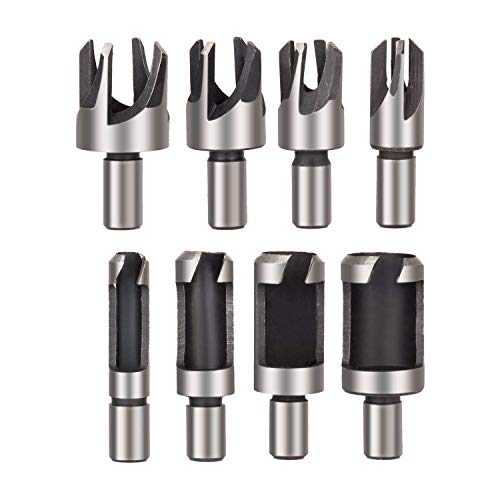
The Rocaris 8-Piece Wood Plug Cutter Set is a high-carbon steel boring accessory bundle featuring four straight and four chamfered cutters in 1/4, 3/8, 1/2, and 5/8-inch sizes. Designed for woodworkers and DIY furniture builders, it chucks into standard manual and electric drills to cut matching grain plugs that conceal screw heads in fine woodworking.
Pros
- Provides both tapered chamfered cutters and straight barrel cutters across four essential woodworking sizes
- Allows woodworkers to cut custom plugs directly from offcuts for matching grain and color
- High-carbon steel material handles hardwoods, softwoods, and composite boards when operated at proper speeds
- Fits standard three-jaw keyless or keyed chucks on manual and electric drills
Cons
- High-carbon steel can overheat and dull prematurely if operated at high drill speeds without cooling intervals
- Lacks a center pilot point, which can cause handheld drills to skate or wander without steady alignment or a drill press
- Round shanks require a standard three-jaw drill chuck and cannot lock directly into 1/4-inch quick-release hex collets
KATA 8-Piece Hole Saw Kit (1-Inch to 2-1/8-Inch)
The KATA 8-Piece Hole Saw Kit supplies five popular hole saw sizes from 1 inch to 2-1/8 inches, forged from heat-treated carbon steel with a protective black coating. Equipped with an arbor mandrel, two pilot drill bits, and a compact case, it provides an accessible accessory set for homeowners and DIYers using standard drills for light residential boring.
Pros
- Supplies five common residential hole saw diameters ranging from 1 inch to 2-1/8 inches
- Includes essential mounting accessories with one mandrel, two pilot bits, and a hex key
- Protective black-coated carbon steel cuts smoothly through PVC, drywall, and softwoods
- Clear plastic storage case keeps components organized and compact in a toolbox drawer
Cons
- Cutting depth is limited to approximately 1 inch (25 mm), preventing deep single-pass cuts through thick dimensional lumber
- Carbon steel construction is strictly not intended for metals, stainless steel, tile, stone, or concrete
- Requires using lower drill speeds and clearing wood chips frequently to prevent binding
Defining Wood Cutters: Mechanics, Categories, and Practical Applications
A wood cutter is any specialized cutting tool, rotary bit, or saw blade engineered to shear wood fibers, produce cylindrical channels, or extract wooden plugs. While the term commonly brings traditional handheld circular or reciprocating saws to mind, it equally describes rotary cutting accessories such as plug cutters and hole saws that chuck into standard drills. Understanding the exact mechanical category required for your project prevents grain tear-out, improves joinery precision, and protects workpiece surfaces.
Primary Tool Classes: Linear Saws Versus Rotary Cutters
Woodworking tools broadly divide into linear cutting saws and rotary cutting accessories based on their mechanical movement. Linear and reciprocating tools, including jigsaws and heavy-duty reciprocating saws, drive toothed blades through continuous strokes to separate lumber along straight or curved paths. In contrast, rotary wood cutters spin about a fixed center to bore wide circular openings or shape cylindrical timber plugs. Both tool classes rely on sharp cutting edges to shear cellulose fibers without shattering adjacent wood cells.
Linear saws excel at stock breakdown, sizing nominal framing lumber, and trimming large sheet goods down to manageable workshop dimensions. Rotary cutting bits handle specialized joinery and boring tasks where a continuous straight kerf is impractical or structurally undesirable. When an installer needs a clean pass-through for conduit, plumbing, or door hardware, a rotary hole saw cores cleanly through face grain without splitting the board. Choosing between these mechanisms depends entirely on whether your cut requires gross dimensional separation or localized circular boring.
How Rotary Wood Plug Cutters Function in Joinery
Wood plug cutters represent a specialized rotary tool class designed specifically for fine cabinetry, furniture assembly, and fastener concealment. Rather than clearing away interior wood as waste, plug cutters bore around a central wooden core to produce matching grain plugs. Sets like the Rocaris 6/10/13/16mm Wood Plug Cutter Drill Bit set provide straight cylindrical cutters alongside four-tooth chamfered cutters in common fractional sizes. Straight cutters produce uniform wooden dowels for filling standard holes, whereas chamfered cutters produce slightly tapered plugs that seat tightly into countersunk screw recesses.
Tapered plugs create a friction fit that wedges securely into screw counterbores, hiding steel fasteners beneath seamless face grain. When woodworkers cut plugs from matching scrap pieces of the same project timber, the grain alignment and color tone blend invisibly across finished surfaces. Operating plug cutters requires steady rotational pressure and rigid support, as these bits lack a central pilot bit and can skate freehand. Securing your board to a drill press table or using a clamped guide block keeps the teeth centered, while light passes prevent burnt rings around the freshly formed plug.
The Mechanics and Geometry of Wood Hole Saws
Hole saws are cylindrical cutting cups equipped with serrated perimeter teeth and a central pilot drill bit mounted to a shared arbor. Kits like the KATA 8PCS Hole Saw Kit 1″ to 2-1/8″ for Wood utilize heat-treated carbon steel bodies to bore large-diameter circular openings across softwoods, plywood, and drywall. The perimeter teeth shear a narrow circular kerf, leaving a solid interior core rather than grinding all the core material into sawdust. This kerf-only removal strategy dramatically reduces motor strain compared to using massive solid spade bits or oversized augers.
The central pilot bit anchors the assembly ahead of the outer cup, preventing dangerous radial deflection while the perimeter teeth engage surface fibers. Once the teeth penetrate the material, the outer cup stabilizes itself within the expanding kerf. Most compact hole saws feature a cutting depth limit of approximately 1 inch, which easily accommodates standard plywood, drywall, and interior boards. When boring through thicker dimensional lumber, drilling halfway from one face and finishing from the opposite side ensures clean entry on both surfaces while preventing the cup from jamming with packed shavings.
Tool Steel Composition: High-Carbon Steel Versus Bi-Metal and Carbide
The cutting efficiency and thermal endurance of any wood cutter hinge on its metallurgical composition. High-carbon steel remains a popular choice for woodworking bits and craft-oriented hole saws due to its excellent edge sharpness and accessible cost. High-carbon alloys take a razor-sharp edge easily, which helps produce clean, tear-free cuts in natural softwoods, pine, and medium-density fiberboard. However, high-carbon steel softens rapidly when exposed to extreme operational heat, making proper feed rates essential.
Industrial saw blades and heavy-duty hole cutters often employ bi-metal construction or tungsten carbide-tipped teeth for increased longevity. Bi-metal tools weld high-speed steel cutting teeth onto flexible spring-steel bodies, providing fatigue resistance when cutting through tough knots or structural framing. Tungsten carbide teeth resist abrasive glues in engineered plywood and composite decking far longer than standard carbon steel. Protective surface treatments, such as black oxide coatings on carbon steel hole saws, help inhibit corrosion in garage workshops and reduce sidewall friction during deep cuts.
Operational Speeds, Feed Rates, and Thermal Management
Managing rotational speed and feed pressure directly controls cut quality across all wood-cutting equipment. Large-diameter hole saws and wide plug cutters require considerably lower rotational speeds than standard twist drill bits. Running an oversized hole saw at maximum drill revolutions generates immediate frictional heat, which scorches the workpiece and dulls the perimeter teeth. As a practical rule, larger cutting diameters require operators to throttle their drill back to low speed while maintaining steady, downward feed pressure.
Thermal management is especially critical when working with resinous softwoods like yellow pine or dense hardwoods like hard maple. Natural wood resins liquefy under friction and bake onto the cutting teeth, forming a sticky glaze that compounds heat buildup. Once pitch accumulates on the cutter shoulders, the teeth lose their clearance angle and begin rubbing rather than cleanly shearing wood fibers. Maintaining a firm, consistent feed rate allows the cutting edges to peel chips smoothly without overloading the motor or stalling inside dense grain.
Chip Evacuation, Gullet Design, and Binding Prevention
Every wood cutter must efficiently evacuate severed timber shavings to prevent binding and motor stall. On perimeter-toothed tools like hole saws, small relief slots along the side of the metal cylinder allow trapped sawdust to escape from the kerf. Without adequate chip clearance, compressed sawdust packs tightly between the tool body and the cut walls. This packed waste material absorbs rotational energy, converts motor power into destructive heat, and can freeze the bit entirely inside the workpiece.
Practicing a pecking technique drastically improves chip evacuation during deep boring operations. By plunging the bit into the wood for a few seconds and then pulling it back slightly while keeping the motor running, the operator clears loose debris from the kerf. This motion pulls packed shavings out of the hole, allowing fresh air to cool the cutting teeth before the next plunge. Similarly, wide clearance gullets on plug cutters fling shaved waste outward, ensuring the extracted plug retains an exact diameter for joinery work.
Clamping, Workpiece Stability, and Drill Alignment
Workpiece stability represents a fundamental requirement for achieving accurate cuts and preventing workshop injuries. Attempting to bore holes or cut plugs in unrestrained boards allows the rotational torque of the tool to spin the workpiece violently. Securing your stock to a sturdy workbench using bar clamps or hold-down dogs keeps the material perfectly rigid. Clamping also isolates your hands from the immediate cutting zone, giving you complete two-handed control over your drill.
Maintaining perpendicular drill alignment ensures that the cutting teeth engage the timber evenly across the entire circumference. If the operator tilts the drill body during the cut, one side of the cutter bites deeper than the other, causing sudden chattering and jagged tear-out. Clamping a sacrificial backer board beneath the workpiece also provides critical support for exiting wood fibers. Without a solid backer board, the downward pressure of the pilot bit and outer teeth will tear out large wood splinters upon breaking through the bottom face.
Evaluating Rotary Cutters Against Traditional Power Saws
Choosing between specialized rotary cutters and traditional saws comes down to cut geometry, material thickness, and project goals. While table saws and circular saws excel at straight rips and crosscuts, they cannot produce localized circular cutouts or extract joinery plugs. Similarly, fine trim work often relies on dedicated workshop stations, where adding miter saw dust hood systems keeps airborne wood particles under control during repetitive angled cuts. Rotary cutting kits complement these larger stationary tools by addressing circular hole boring and fastener concealment tasks that saws cannot perform.
Handheld jigsaws provide an alternative method for cutting curved profiles, but they struggle to match the speed and precision of a dedicated hole saw. Guiding a jigsaw freehand along a tight circular line requires layout marking, steady hand control, and subsequent edge sanding. A hole saw produces a uniform round hole in seconds, making it the preferred choice for repetitive boring tasks like cable grommets or pipe pass-throughs. For joinery concealment, plug cutters remain unmatched because no saw blade can produce matching grain plugs to hide screw counterbores.
Essential Workshop Safety Protocols and Equipment Care
Operating high-torque wood cutters requires constant attention to workshop safety and appropriate personal protection. Rotary cutters and hole saws can snag suddenly on internal grain knots or dense plywood layers, transferring sharp rotational torque into the operator’s wrists. Always maintain a firm, balanced two-handed grip on your drill, and utilize an auxiliary side handle whenever drilling large diameters. Wearing ANSI-certified safety glasses protects your eyes from high-speed airborne shavings and splintered wood chips.
Appropriate workshop clothing and routine tool hygiene prevent accidents while extending the operational life of your cutting equipment. Operators should avoid wearing loose-fitting sleeves, dangling necklaces, or work gloves that could catch on spinning cutting cups. After completing a project, remove accumulated resin from cutter teeth using a mild citrus-based cleaner or brass wire brush. Storing hole saw cups, mandrels, and plug cutters in dry, organized cases prevents tooth chipping and keeps carbon steel surfaces protected from humidity.
Understanding the broad definition of a wood cutter allows you to choose the exact tool required for your specific woodworking challenges. Whether you are boring clean pass-throughs with a carbon steel hole saw or cutting matching timber plugs to conceal joinery screws, proper speed control and rigid workpiece clamping make all the difference. Matching your tool geometry to the task preserves your material, extends bit life, and delivers professional, clean results across every home build and workshop repair.
About the author

Thomas Gaige combines mechanical engineering knowledge with extensive hands-on construction experience. His background includes engineering, AutoCAD design, general contracting, residential and light-commercial construction, automotive restoration, cabinetry, fabrication, and workshop projects. This combination gives him a practical framework for evaluating tools based on engineering, performance, usability, and jobsite demands.