
Best Saw to Cut Dowels Flush of 2026 for Clean Trim Cuts
Trimming wooden plugs cleanly requires precision. Review the Best Saw To Cut Dowels Flush options for October 2026 to protect your wood surfaces from ugly gouges.
 By Tony Flanders
Updated October 2, 2026
By Tony Flanders
Updated October 2, 2026

Gouging a finished cabinet face while trimming an exposed tenon or wooden plug can ruin hours of careful joinery. Standard push saws often bite too aggressively into surrounding wood fibers because their teeth feature an outward set designed for clearing rough kerfs. That is why finding the best saw to cut dowels flush comes down to picking a tool with zero tooth set and an ultra-thin, flexible blade. Japanese pull saws excel at this task by holding tension on the pull stroke, allowing woodworkers to press the blade flat against the workpiece without digging deep scratches into the surrounding grain.
A quality flush-cutting hand tool relies on high-grade carbon steel like SK5, paired with a high tooth count per inch (TPI) to deliver clean shearing action across end grain. Careful analysis of blade geometry, flexibility, and handle ergonomics reveals that fine teeth between 17 and 25 TPI prevent tear-out on brittle dowels. Whether you need a double-edge ryoba blade to tackle both hardwoods and softwoods or a compact single-edge pull saw for tight corners, matching the blade profile to your project prevents costly surface repairs.
| Award | Product | TGH Score About TGH ScoreThe TGH Score is our own rating from 0 to 10, based on performance, design and build, ease of use, and value. It reflects independent research and is never influenced by manufacturers, retailers, or affiliate commissions. Learn more › | |
|---|---|---|---|
| Best Overall |
JORGENSEN Japanese Flush Cut Saw
|
9.2/10 | Buy |
| Best Budget |
 Japanese Saw, Japanese Hand Saw Ryoba Saw
|
9.1/10 | Buy |
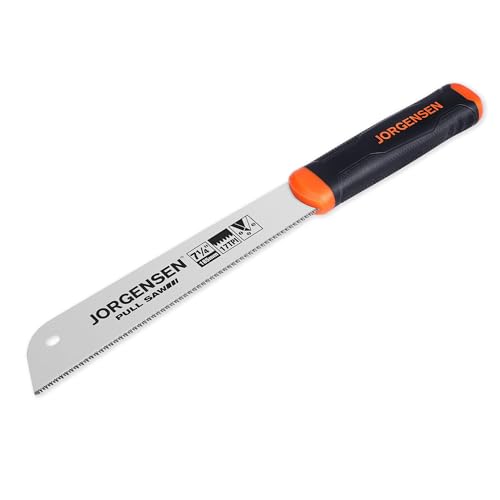 JORGENSEN Japanese Pull Saw
|
9.1/10 | Buy | |
| Best Premium |
 Temple Tool Co. Japanese Flush Cut Saw
|
9.1/10 | Buy |
| Best Value |
 SUIZAN Flush Cut Saw 5"
|
8.6/10 | Buy |
 Japanese Hand Saw, 6-Inch Double-Edge Pull Saw
|
8.3/10 | Buy | |
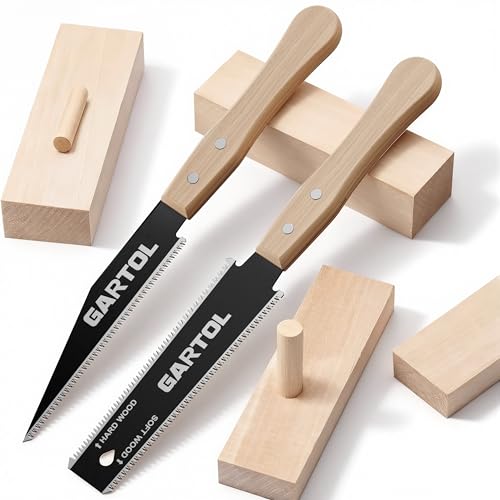 GARTOL Hand Saw for Wood Cutting
|
8.0/10 | Buy |
Frequently Asked Questions About Flush Cutting Saws
Why do Japanese pull saws cut on the pull stroke instead of the push stroke?
Pull-stroke cutting keeps the thin steel blade under tension so it will not buckle or bind during the cut. Because the blade remains straight under tension, manufacturers can produce much thinner kerfs than traditional Western push saws. This thin-kerf design removes less material and requires significantly less downward force, giving woodworkers precise control when skimming right against a flat panel.
What tooth set is necessary for the Best Saw To Cut Dowels Flush?
A zero tooth set is essential to prevent leaving gouges and scratches across the adjacent finished wood. Unlike standard hand saws where teeth alternate outward to clear sawdust, flush-cut blades have teeth ground flat along the cutting face. This design allows the flexible SK5 steel plate to rest directly against the workpiece without abrasive tooth edges marring the surface.
What TPI rating works best for trimming dense hardwood dowels?
A blade with 17 to 25 TPI provides the cleanest shearing action on dense hardwood dowels like oak, maple, and walnut. Finer teeth take smaller bites out of end-grain fibers, which dramatically reduces splintering and tear-out. Coarser blades below 14 TPI cut faster but can leave rough ridges that demand excessive sanding or chisel work later.
Can a standard push saw or coping saw work for cutting dowels flush?
No, standard push saws and coping saws are poorly suited for flush cutting because their tooth set scratches adjoining surfaces immediately. Push saws also rely on thicker, rigid steel blades that cannot flex flat against a board. Attempting to trim plugs with a rigid blade forces an angled cut that leaves a protruding stub or digs directly into the surrounding veneer.
How do you protect the surrounding workpiece while using the Best Saw To Cut Dowels Flush in 2026?
Placing a thin strip of painter tape or a sheet of paper under the blade provides a protective barrier against inadvertent friction marks. You can rest the flexible blade against the taped surface, slice through the dowel with light pulling strokes, and finish the final fraction of a millimeter with a sharp hand chisel or card scraper. This simple workshop technique guarantees zero scratches on fine furniture.
What is the advantage of a double-edge ryoba blade for dowel trimming?
A double-edge ryoba blade offers two distinct cutting profiles on a single tool, typically featuring fine crosscut teeth on one edge and coarser teeth on the other. This dual-edge configuration lets woodworkers switch between softwoods and hardwoods without swapping tools. For flush trimming, the finer crosscut edge delivers the splinter-free finish needed on exposed plugs and tenons.
About the author
Tony Flanders is an experienced astronomy writer and observer with a background in mathematics, technical research, and science communication. His extensive observing experience includes exploring deep-sky objects through different telescope configurations. He specializes in making complex astronomical concepts accessible to beginners and experienced observers alike.