
Best Saw for Cutting Kitchen Units Without Chipping of 2026 For Clean Cuts
Prevent ruined laminate with the best saw for cutting kitchen units without chipping in October 2026 using precision blades and steady control.
 By Tony Flanders
Updated October 2, 2026
By Tony Flanders
Updated October 2, 2026

Chipped melamine and splintered veneer can ruin an expensive kitchen install in seconds. Melamine surfaces on particleboard core are notorious for blowouts because standard blades pull fibers upward rather than slicing cleanly. Selecting the best saw for cutting kitchen units without chipping requires looking closely at tooth count, blade kerf thickness, and cutting stroke direction. Fine Japanese pull saws with razor-sharp SK5 steel teeth and compact convertible table saws with high-torque 12A motors offer the rigidity needed to score delicate laminate without tearing.
Based on manufacturer specifications and feedback from experienced workshop fitters, keeping feed pressure steady and matching tooth geometry to coated boards is the key to clean edges. Whether you tackle scribe fillers with a flexible flush-cut hand saw or rip cabinet carcasses using a cast aluminum table top with a rigid rip fence, having zero blade wobble saves hours of tedious edge-banding repairs. Look for cutting gear designed to keep every cabinet joint crisp and gap-free.
| Award | Product | TGH Score About TGH ScoreThe TGH Score is our own rating from 0 to 10, based on performance, design and build, ease of use, and value. It reflects independent research and is never influenced by manufacturers, retailers, or affiliate commissions. Learn more › | |
|---|---|---|---|
| Best Overall |
SUIZAN Flush Cut Saw 5"
|
8.6/10 | Buy |
| Best Premium |
 Evolution R8MTS 8-1/4" Convertible Miter/Table Saw
|
8.1/10 | Buy |
| Best Budget |
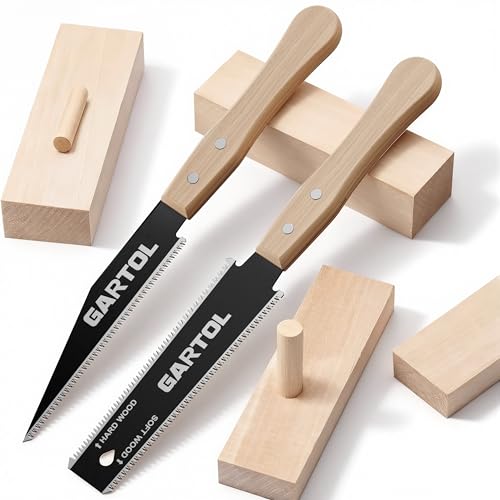 GARTOL Hand Saw for Wood Cutting
|
8.0/10 | Buy |
 JORGENSEN 10" Dovetail Reversible Saw
|
8.0/10 | Buy |
Frequently Asked Questions
Can a Japanese pull saw cut laminate kitchen units without chipping?
Yes, Japanese pull saws excel at clean cuts because the teeth cut on the pull stroke, pulling veneer fibers inward toward the core rather than ripping them outward. The thin kerf and high tooth density on flexible SK5 steel blades minimize surface blowouts. Many cabinet installers rely on them for trimming end panels, scribing filler strips, and making flush cuts without marring adjacent cabinet surfaces.
What blade tooth count is needed to avoid chipping kitchen cabinets?
A blade with 13 TPI or higher for hand saws, and fine-finish carbide teeth for power saws, is recommended for chip-free cuts. Coarse blades with low tooth counts grab the brittle melamine coating and tear chunks away from the substrate. Blades designed with alternate top bevel or triple-chip grind teeth shear the laminate cleanly before cutting into the inner composite core.
Should you score the cutline before cutting kitchen units?
Yes, pre-scoring your cutline with a sharp utility knife or a fine hand saw prevents surface chipping. By cutting through the delicate decorative veneer layer first, the main saw teeth cannot lift the laminate during crosscuts or rip cuts. Applying low-tack painter’s tape directly over the cutline also provides extra surface tension to prevent chipping on melamine panels.
How does the Evolution R8MTS prevent chipping when cutting kitchen panels?
The Evolution R8MTS minimizes edge tear-out by utilizing a multi-material TCT blade, a rigid cast aluminum table, and a dual-locking rip fence. The secure fence prevents board chatter, which is a primary cause of micro-chipping along panel edges. Operating with a 12A motor, it maintains steady rotational speed through particleboard and dense hardwoods alike.
Why do table saws often chip the top side of kitchen cabinets?
Standard table saw blades rotate downward toward the front of the table, exiting through the bottom of the workpiece when cutting from above. As a result, the bottom side usually experiences tear-out while the top remains clean, though dull teeth or vibration can still chip the top veneer. Placing the decorative face upward on a table saw or using a zero-clearance insert protects fragile kitchen cabinet surfaces.
Is a flexible flush cut saw effective for kitchen cabinet filler strips?
Yes, a flexible flush cut saw allows you to trim filler strips right against walls or adjacent base units without marring finished surfaces. Because the blade has no aggressive tooth set on one side, it glides flat against guiding edges. This provides the micro-adjustment control required to eliminate unsightly gaps along uneven drywall in 2026.
About the author
Tony Flanders is an experienced astronomy writer and observer with a background in mathematics, technical research, and science communication. His extensive observing experience includes exploring deep-sky objects through different telescope configurations. He specializes in making complex astronomical concepts accessible to beginners and experienced observers alike.