
Best Tablesaw Blade for General Use of 2026 for Clean Cuts
Upgrade your workshop cuts with the best tablesaw blade for general use options updated for October 2026, reducing tear-out and motor drag across every pass.
 By Tony Flanders
Updated October 2, 2026
By Tony Flanders
Updated October 2, 2026

Rough tear-out along expensive hardwood boards and persistent motor drag during heavy rip cuts often trace right back to an improper plate setup. Standard factory blades regularly cause burning on dense lumber and leave splintered edges on sheet goods when their tooth profile fails to clear chips efficiently. Equipping your workshop with the best tablesaw blade for general use provides the necessary balance between fast material removal and smooth crosscutting precision. Careful analysis of tooth geometry, plate balance, and carbide grades reveals that dedicated multipurpose designs significantly minimize cutting resistance while maintaining crisp, true lines.
Thin kerf designs relieve stress on standard 15-amp jobsite and hybrid saws, allowing lower-horsepower motors to slice cleanly without bogging down or triggering thermal overload switches. Selecting an optimal plate with laser-cut expansion slots and high-density carbide tips prevents heat-induced blade warping during extended cutting sessions. Reviewing verified user feedback and manufacturer specifications indicates that an alternate top bevel configuration delivers clean results across plywood, dimensional softwoods, and abrasive composite panels alike.
| Award | Product | TGH Score About TGH ScoreThe TGH Score is our own rating from 0 to 10, based on performance, design and build, ease of use, and value. It reflects independent research and is never influenced by manufacturers, retailers, or affiliate commissions. Learn more › | |
|---|---|---|---|
| Best Overall |
DEWALT Table Saw Blade, 10", 40 Tooth
|
8.9/10 | Buy |
| Best Premium |
 FOXBC 10-Inch Table Saw Blade, 80-Tooth
|
8.8/10 | Buy |
| Best Value |
 DEWALT 10-Inch Miter / Table Saw Blade, ATB
|
8.1/10 | Buy |
| Best Budget |
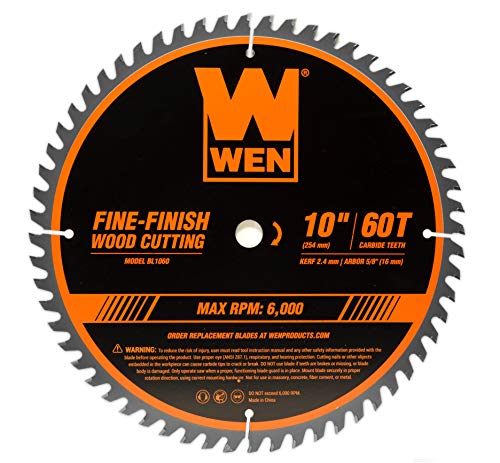 WEN BL1060 10-Inch 60-Tooth Fine-Finish
|
8.0/10 | Buy |
Frequently Asked Questions
How many teeth should the best tablesaw blade for general use have for versatile workshop tasks?
A 40-tooth to 50-tooth configuration offers the best all-around balance for general table saw cutting. Blades with 24 teeth rip quickly through wet construction lumber but leave ragged edges during crosscuts. Conversely, 60-tooth to 80-tooth plates deliver glass-smooth cuts on fine trim and veneers but risk scorching hardwood during lengthy rip operations. A balanced 40-tooth alternate top bevel plate handles both ripping and crosscutting without requiring frequent tooling swaps.
Does a thin kerf blade perform better on jobsite and portable table saws?
Yes, a thin kerf blade removes less material, which reduces motor strain on portable and jobsite saws. Standard contractor or jobsite saw motors can struggle with full 1/8-inch kerf plates during dense hardwood rip cuts. The narrower kerf, typically around 3/32-inch (0.098 inches), demands less amperage and minimizes feed resistance. This allows portable cutting setups to sustain higher rotational speeds without binding or tripping breakers.
Can you use a 10-inch miter saw blade on a table saw?
Yes, provided the arbor diameter, plate thickness, and tooth hook angle match your table saw requirements. Most 10-inch woodworking saws utilize a standard 5/8-inch arbor, making physical mounting straightforward across platforms. However, miter blades frequently employ a negative or low positive hook angle to prevent material climb, which requires slightly firmer feed pressure during table saw rips. Verifying riving knife thickness compatibility is vital because a thin kerf plate must remain wider than the saw splitter to avoid dangerous binding.
What is the difference between ATB and flat-top grind teeth on a table saw blade?
Alternate Top Bevel (ATB) teeth shear wood fibers cleanly for smooth crosscuts, while flat-top grind teeth act like chisels to clear waste during rips. ATB teeth alternate angled tips to slice through grain without tearing veneer or splintering plywood faces. Flat-top teeth excel at clearing flat-bottom grooves and tracking straight through thick lumber. Combination blades frequently pair four ATB teeth with one flat-top raker to balance chip clearance with crisp surface quality.
How often should you clean or replace your best tablesaw blade for general use in 2026?
Regular cleaning every few months restores cutting efficiency, while replacement or professional sharpening is needed only when carbide teeth chip or dull. Baked-on pitch and sap create friction that mimics a dull edge, causing burning and excessive feed resistance. Soaking the plate in a specialized resin remover often revives crisp cutting action immediately. If the carbide edges feel rounded under a fingernail or show micro-fractures, sending the plate to a sharpening service or installing a fresh replacement is necessary.
About the author
Tony Flanders is an experienced astronomy writer and observer with a background in mathematics, technical research, and science communication. His extensive observing experience includes exploring deep-sky objects through different telescope configurations. He specializes in making complex astronomical concepts accessible to beginners and experienced observers alike.