
How to Rip Straight With a Circular Saw: Practical Guide for 2026
Learn how to rip straight with a circular saw using proven guide setups and clean cutting techniques to prevent wander and kickback in November 2026.
 By Bradley Ford
Updated November 5, 2026

Ripping down full sheets of plywood or truing up framing lumber often challenges woodworkers who lack a stationary cabinet table saw. Discovering how to rip straight with a circular saw transforms a standard handheld power tool into a reliable cutting system capable of slicing sheet goods with workshop-level accuracy. Achieving dead-straight cuts requires eliminating freehand guesswork by pairing your saw with rigid straightedges, calibrated rip fences, and proper workpiece support. When setting up a dependable worksite, pairing your cutting tools with versatile accessories like multi-head drill driver systems makes building jigs and assembling components far more efficient.
Freehand cutting over four or eight feet inevitably introduces wandering kerfs, unsightly edge burning, and dangerous blade binding that can trigger sudden kickback. Understanding how the saw shoe plate registers against a reference fence allows both DIY remodelers and finish carpenters to achieve splinter-free edges on delicate cabinet veneers and structural framing lumber. While heavy outdoor jobs might demand rugged equipment like high-capacity cordless outdoor cutting tools, precision ripping inside the workshop demands disciplined saw alignment and controlled feed rates. Mastering these core principles ensures repeatable cuts while safeguarding your hands and preserving expensive materials.
| Award | Product | TGH Score About TGH ScoreThe TGH Score is our own rating from 0 to 10, based on performance, design and build, ease of use, and value. It reflects independent research and is never influenced by manufacturers, retailers, or affiliate commissions. Learn more › | |
|---|---|---|---|
| Best Overall |
IMeanTop 24-Inch Circular Saw Roller Guide
|
9.2/10 | Buy |
| Best Budget |
 Hugexpen MZ745 Circular Saw Rip Fence Edge Guide |
9.1/10 | Buy |
| Best Value |
 Milescraft 1403 Universal Saw Guide |
8.4/10 | Buy |
| Best Premium |
 SKIL 5280-01 15-Amp 7-1/4-Inch Circular Saw |
8.4/10 | Buy |
 The zowu 49-22-4146 Rip Fence Kit |
8.3/10 | Buy | |
 Milescraft 1404 24-Inch Rip Saw Guide |
8.3/10 | Buy | |
 TMFNX 12-Inch Circular Saw Rip Fence Guide |
8.1/10 | Buy | |
 Aunocy 24-Inch Circular Saw Rip Guide |
8.1/10 | Buy | |
 Ameri 49-22-4146 Circular Saw Rip Fence Kit |
8.0/10 | Buy |
IMeanTop 24-Inch Circular Saw Roller Guide
Designed for repeatable rip cuts, this stainless steel edge guide uses four bearing rollers to track smoothly along sheet goods. It streamlines straight cuts with a clear measurement scale, provided your circular saw shoe fits its 10mm by 3mm mounting rod.
Pros
- Smooth four-roller bearing guide system
- Durable stainless steel construction
- Clear measurement markings for quick setup
- Facilitates straight and repeatable cuts
Cons
- Requires specific 10mm by 3mm saw slot
- Cutting capacity capped at 24 inches
Hugexpen MZ745 Circular Saw Rip Fence Edge Guide
The Hugexpen MZ745 is an affordable replacement rip fence engineered for compatible worm drive circular saws to deliver fast, repeatable parallel cuts. Designed to replace Skil OEM part numbers 13896 and 2 610 034 814, it is a practical addition for framers and remodelers ripping sheet goods.
Pros
- Cost-effective replacement for lost or bent Skil OEM edge guides
- 13-inch bar length offers useful reach for common rip widths on sheet goods
- Sturdy construction helps keep cuts controlled without excessive flex
- Simplifies repeated rips across 2x lumber, plywood, and OSB panels
Cons
- Not compatible with Skil model 553 circular saws
- Lacks fine micro-adjustment graduations, requiring manual rule alignment before tightening
- Saw baseplate thumbscrew is not explicitly listed as included
Milescraft 1403 Universal Saw Guide
The Milescraft 1403 Universal Saw Guide is a versatile attachment that guides circular saws for rip cuts up to 14 inches and jig saws for circles up to 24 inches. It is an ideal, budget-friendly option for DIYers and woodworkers seeking repetitive cut consistency without lugging around heavy stationary machinery.
Pros
- Universal baseplate mounting system accommodates a broad variety of circular saw and jigsaw models
- Dual functionality supports both straight rip cuts up to 14 inches and jigsaw circles up to 24 inches
- Reversible fence design maintains consistent tracking along board edges throughout the cut
- Lightweight one-pound design is easy to store, transport, and mount as needed
Cons
- Rip capacity is limited to 14 inches, requiring other guide methods for wide panel breakdowns
- Universal clamp alignment requires careful manual verification to ensure the saw blade runs parallel to the fence
- Lightweight frame can flex if excessive lateral pressure is applied against the workpiece edge
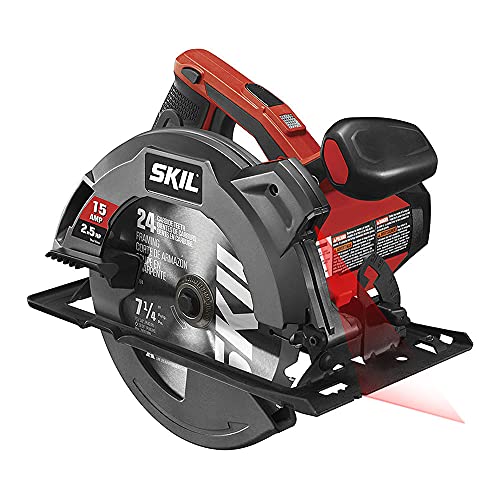
SKIL 5280-01 15-Amp 7-1/4-Inch Circular Saw
The SKIL 5280-01 is a corded 7-1/4-inch circular saw featuring a 15-amp motor delivering 5,300 RPM, an integrated single beam laser, and a 51-degree bevel capacity. It provides dependable cutting performance for DIY homeowners, weekend woodworkers, and remodelers tackling dimensional lumber and sheet goods.
Pros
- Powerful 15-amp corded motor maintains 5,300 RPM for reliable crosscutting and ripping
- Wide 51-degree bevel range with a positive detent at 45 degrees expands cutting options
- Integrated dust blower and single beam laser improve cutline awareness during operation
- Manageable 8.7-pound weight reduces operator fatigue during overhead or repetitive cutting
Cons
- Lacks an electronic blade brake, meaning the blade coasts to a stop after trigger release
- Laser guide alignment should be checked and verified against a manual square before precision cuts
- Supplied carbide-tipped blade is suited for general rough cutting rather than fine cabinet trim
The zowu 49-22-4146 Rip Fence Kit
Designed to streamline repetitive cuts, this aftermarket guide fence mounts securely to select corded circular saws to deliver straight, precise lines. It serves as an accessible replacement for workshop maintenance and quick rip-cut operations.
Pros
- Direct replacement for part 49-22-4150
- Secures firmly to maintain cutting precision
- Durable high-strength construction
- Simple to install and operate
Cons
- Compatible only with specific circular saw models
- Not designed for universal saw fitment
Milescraft 1404 24-Inch Rip Saw Guide
Designed for rip and cross cuts on sheet goods, the Milescraft 1404 clamps securely to most circular saws up to 7-1/4 inches. Its rigid all-metal base and laser-etched guide help maintain straight tracking across widths up to 24 inches.
Pros
- Sturdy all-metal base minimizes guide rail flex
- Four clamping points hold saws firmly in place
- Clear laser-etched scale markings for precise setup
- Broad compatibility with sidewinder and worm-drive saws
- Rubber-coated plate grips circular saw tightly
Cons
- Cutting range is limited to 24 inches maximum
- Not compatible with saws larger than 7-1/4 inches
- Bulky 30.5-inch length requires ample storage space
TMFNX 12-Inch Circular Saw Rip Fence Guide
The TMFNX 12-Inch Circular Saw Guide is a stainless steel rip fence attachment engineered with smooth roller tracking and laser-etched calipers for repeatable parallel cuts. It provides DIYers, trim installers, and cabinetmakers with controlled ripping precision on sheet goods without having to manage bulky full-length tracks.
Pros
- Smooth-rolling edge contact helps eliminate drag and catching against rough lumber edges
- Heavy-duty stainless steel construction provides dependable rigidity compared to thin stamped-aluminum fences
- Laser-etched markings resist abrasion from workpiece contact and sawdust buildup
- Compact footprint fits easily into standard toolboxes and mobile contractor bags
- Calipers enable straightforward width adjustments without complex alignment fixtures
Cons
- Maximum 12-inch guide reach restricts use to narrow ripping tasks rather than breaking down full 4x8-foot sheet centers
- Requires initial squareness verification with a machinist square against your saw blade before tightening down
- Cutting accuracy depends directly on the straightness and smoothness of the reference board edge
Aunocy 24-Inch Circular Saw Rip Guide
Built with a rigid stainless steel body and laser-etched imperial markings, this rip cut attachment helps standard circular saws deliver straight, repeatable cuts up to 24 inches wide. A roller-bearing positioning fence glides along board edges to minimize friction and prevent binding during sheet breakdowns.
Pros
- Stiff stainless steel track resists bending
- Clear inch markings eliminate conversion math
- Roller-bearing fence glides smoothly without binding
- Enables quick, repeatable cuts up to 24 inches
- Compatible with left- and right-blade saws
Cons
- Cutting capacity is limited to 24 inches
- Tailored primarily for standard 7-1/4-inch circular saws
Ameri 49-22-4146 Circular Saw Rip Fence Kit
Built as a direct replacement for fence model 49-22-4150, this guide rail provides steady tracking for repetitive straight cuts. Dual thumb screws allow quick adjustments on compatible circular saws like the 6405-6.
Pros
- Dual thumb screws allow quick and easy adjustments
- Rigid high-strength build resists bending over time
- Directly replaces discontinued fence model 49-22-4150
- Wide 6-inch profile stabilizes straight rip cuts
Cons
- Compatibility is restricted to specific listed saw models
- Lacks integrated measurement markings on the guide rail
Essential Techniques for Ripping Straight with a Handheld Circular Saw
Ripping boards cleanly along their length demands firm mechanical guidance rather than relying solely on visual cutline tracking. A circular saw blade naturally follows the path of least resistance, meaning slight variations in grain density, hand tremor, or shoe tilt will deflect the cut. By securing a rigid straight reference, dialing in blade projection, and stabilizing the workpiece, you can achieve table-saw precision across any worksite.
Workpiece Support and Eliminating Kerf Pinch Kickback
Supporting sheet goods properly forms the absolute foundation of straight, safe ripping. Never suspend a 4×8 sheet between two isolated sawhorses where the center can sag under its own weight as the cut progresses. When the waste side or keeper board droops, the kerf narrows rapidly, clamping down on the spinning blade teeth and causing violent rotational kickback. This sudden binding can throw the saw off track and damage both the board and the operator.
Placing a solid sheet of rigid extruded polystyrene insulation foam directly beneath your plywood on the floor or work table provides continuous, zero-sag support across the entire cutline. The circular saw blade simply slices slightly into the sacrificial foam board without damaging the work surface or pinching the kerf. This approach keeps both halves of the sheet completely flat and motionless from start to finish, preventing accidental bind-ups.
For narrow dimensional lumber, clamp the keeper board firmly to sturdy workbench rails while letting the narrow offcut drop away freely. When an offcut can release without restriction, internal wood tension cannot close the kerf behind the blade body. Consistent, stable workpiece clamping also frees both of your hands to control the saw handles securely throughout the pass.
Calibrating Blade Depth and Shoe Plate Parallelism
Adjusting blade depth correctly is a critical technical factor in minimizing cut wandering and surface splintering. Loosen the depth adjustment lever and position the base shoe so the lowest carbide tooth extends only 1/8 to 1/4 inch past the bottom face of the workpiece. Exposing several inches of blade beneath the cut creates excessive surface drag, increases heat buildup, and multiplies kickback severity if the saw binds.
Shallow blade projection creates an optimal shearing angle where the carbide teeth enter the top surface cleanly and exit downward through the bottom face. This shallow entry significantly reduces face-veneer tear-out on delicate cabinet plywood and birch sheet goods. Furthermore, less blade surface inside the cut reduces lateral friction, allowing the saw motor to maintain peak cutting speed.
Before making critical cuts, verify that the saw shoe plate sits dead parallel to the blade body. A bent or warped shoe plate, often caused by jobsite drops, forces the blade to track at a slight crabbed angle relative to the guide edge. When the shoe edge and blade body are out of alignment, the blade heel binds against the kerf wall, causing wood burning and pushing the tool away from your straightedge.
Evaluating Parallel Rip Fences and Positioning Calipers
Shoe-mounted rip fences provide a fast, portable solution for making narrow, parallel cuts without clamping long straightedge boards. Attachments such as the MZ745 Adjustable Circular Saw Rip Fence and Edge guide insert directly into the front mounting slots of compatible saw shoes, allowing quick repetitive cuts on dimensional lumber. Similarly, the 49-22-4146 Circular Saw Guide Rip Fence Kit and the 49-22-4146 Circular Saw Guide Rip Fence Kit replacement options secure across the shoe plate with thumbscrews to maintain consistent spacing from the board edge.
While basic stamped-metal fences work well for narrow cuts, wider sheet goods benefit from extended positioning calipers equipped with bearing rollers. The IMeanTop 24″ Positioning Calipers for Circular saw utilizes four smooth bearing rollers that glide along the sheet edge to reduce sliding friction and prevent snagging. In a similar manner, the Aunocy Circular Saw Guide Rail features a 24-inch stainless steel arm and a multi-bearing caliper with laser-engraved imperial markings for dependable width settings.
Compact projects and trim repairs often require shorter guides that maneuver comfortably in confined spaces. The 12 Inch Circular Saw Guide offers a durable stainless steel rail and roller guide designed for quick trim slicing and cabinet sizing without unwieldy overhang. Choosing between a standard slide fence and a roller caliper depends heavily on the edge smoothness of your stock, as bearing rollers easily traverse rough factory plywood edges without catching.
Using Clamped Straightedges and Universal Sled Guides
For ripping full 4×8 panels wider than 24 inches, clamping a rigid straightedge directly across the workpiece represents the gold standard for workshop accuracy. You can use a commercial aluminum cutting guide, a heavy-duty box-beam level, or a factory-straight strip of 1/2-inch birch plywood clamped at both ends with low-profile bar clamps. The shoe plate of your saw rides directly against this straightedge, providing an unyielding mechanical barrier that prevents freehand drifting.
To prevent saw shoe flex when gliding along extended guides, universal sled attachments provide a wider, more rigid mounting base. The Milescraft 1404 Rip Saw Guide incorporates an all-metal base plate with four clamping points and rubber pads to lock corded or cordless saws securely in place. By eliminating base plate deflection across its 24-inch edge range, this system maintains rigid alignment between the saw motor and the guide fence.
Multipurpose systems also allow woodworkers to switch between different tool types depending on the project requirements. The Milescraft 1403 Universal Saw Guide for Circular and jig saws provides a reversible edge guide extending up to 14 inches for straight cuts, while also accommodating jigsaw circle cuts up to 24 inches. Selecting an all-metal universal sled ensures that your setup resists bending, especially when applying steady inward pressure along a long plywood rip.
Calculating the Shoe Offset Distance for Exact Cuts
When clamping an external straightedge, positioning the guide correctly requires calculating your saw specific shoe offset distance. Measure the precise gap from the outer edge of your circular saw shoe plate to the inside edge of the cutting blade teeth. Because circular saw shoes are asymmetrical, this offset measurement differs significantly depending on whether you register the motor side or the blade side against the guide.
If the distance from your shoe edge to the blade teeth is exactly 1-1/2 inches, your straightedge guide must be clamped exactly 1-1/2 inches away from your intended cutline. Always measure to the blade tooth tips rather than the flat blade body, as the tooth kerf extends slightly beyond the steel plate. For clean jobsite setups, woodworkers frequently pre-drill pilot holes with compact brushless cordless drills to fasten stop blocks or dedicated alignment jigs.
Building a custom zero-clearance cutting board eliminates the need to measure this offset mathematically on every individual cut. Fasten a factory-straight guide fence atop a thin hardboard or plywood base, then run your circular saw along the fence to trim the base edge flush with your blade kerf. On future projects, simply aligning the trimmed edge of the base directly with your layout pencil marks guarantees exact cut placement every time.
Executing the Cut with Controlled Body Posture and Feed Rate
Executing a straight, steady cut requires deliberate body mechanics and balanced forward momentum. Position your body slightly to the side of the cut path rather than standing directly in line with the spinning blade to stay completely clear of the kickback zone. Place one hand firmly on the main rear trigger grip and the secondary hand on the front auxiliary pommel to maintain dual-axis control.
Place the front of the saw shoe flat on the workpiece and tight against the guide fence before engaging the power switch. Allow the motor to spin up to its full operating speed, such as the 5,300 RPM delivered by the SKIL 15 Amp 7-1/4 Inch Circular Saw with Single beam laser guide model, before bringing the spinning blade into contact with the wood. Entering the stock before reaching full speed can cause the teeth to grab, violently jerking the saw backward.
Push the saw forward with steady, continuous pressure while applying gentle lateral pressure toward the guide fence. Avoid forcing the feed rate, which bogs down the motor and causes thin-kerf blades to flex sideways inside the cut. When balancing motor performance on extensive renovation jobs, weighing corded versus cordless power tools helps clarify how steady line voltage maintains constant blade speed without battery depletion.
Continue your forward stride smoothly across long eight-foot panels without pausing mid-cut. Stopping your forward progress while the blade is spinning under power generates localized heat, creating dark friction scorch marks on the wood edge. Push the saw all the way through until the blade guard snaps completely closed over the teeth, and let the blade spin to a complete stop before lifting the tool away.
Blade Selection and Tooth Geometry for Straight Ripping
Blade geometry plays an enormous role in maintaining straight tracking through dense grain patterns. Ripping solid hardwoods or softwoods along the grain generates long, continuous wood ribbons that require wide, deep tooth gullets to clear effectively. A dedicated 24-tooth framing or ripping blade features spacious gullets that evacuate chips rapidly, preventing the blade from clogging, overheating, and flexing off course.
When ripping delicate cabinet plywood, prefinished veneer panels, or melamine sheets, a high tooth count becomes essential to prevent ragged splintering. Switching to a 40-tooth or 60-tooth alternate top bevel (ATB) blade shears surface wood fibers cleanly on both sides of the kerf. While high tooth counts produce satin-smooth edges, they require a slightly slower, highly consistent feed rate to avoid overloading the smaller tooth gullets.
Kerf thickness also influences blade deflection and straight-line tracking. Thin-kerf blades remove less material and reduce strain on cordless battery motors, but their thinner steel plates are more susceptible to wobbling under aggressive feed pressure. Full-kerf blades feature thicker steel bodies that resist lateral deflection, making them particularly reliable for maintaining straight reference cuts through knotty, uneven dimensional lumber.
Troubleshooting Wandering Cuts and Edge Burning
When a circular saw repeatedly drifts away from your guide line, the cause is usually related to uneven lateral pressure or a misaligned shoe plate. Forcing the saw too hard against a flexible straightedge can bow the guide outward in the middle of a four-foot or eight-foot pass, resulting in a curved cutline. Inspect your straightedge with a precision level to confirm it remains completely straight under moderate sideways contact.
Pitch, resin, and sap buildup on carbide teeth also drastically degrade cutting accuracy and generate severe burn marks along the kerf. Sticky sap increases friction against the wood fibers, causing localized heat buildup that warps the blade plate into a slight dish shape while spinning. Soaking the blade in specialized citrus pitch cleaner dissolves stubborn resin residues, restoring cool operation and true tracking.
Poor cutline visibility can also cause operators to lose focus on shoe contact and drift off course. Integrated features like forward dust blowers and laser alignment lines, such as those found on the SKIL 5280-01, actively clear sawdust off your layout marks and keep the blade path visible. Keeping your cut path clear of sawdust allows you to monitor shoe registration against the guide fence without straining or shifting your stance.
Verification and Post-Cut Inspection Protocols
Once you complete your rip cut and release the trigger switch, let the electric brake or blade inertia bring rotation to a complete stop before resting the tool on your bench. Immediately inspect the retractable lower blade guard to verify that its internal torsion spring snaps the shield closed fully over the blade. Never set a saw down with an exposed spinning blade or a sticking lower guard.
Check the quality and squareness of the freshly ripped board using a reliable machinist square or speed square along multiple points of the edge. A properly executed cut should show a crisp 90-degree edge relative to the face with no visible scalloping, stepping, or heat discoloration. If the edge bevels slightly out of square, adjust the bevel quadrant stop on your saw shoe until the blade locks dead vertical.
Developing a disciplined cutting routine that combines rigid guides, proper blade projection, and continuous board support guarantees straight, accurate cuts on every project. Taking the extra two minutes to clamp a straightedge and verify saw alignment saves expensive sheet goods from the scrap bin while ensuring exceptional joinery results.
About the author

Bradley Ford is an experienced hands-on tool tester with a background in farm equipment, welding, mechanical repair, and classic automobiles. His practical experience includes repairing and servicing high-end vehicles as well as testing tools, generators, lawn equipment, and workshop gear. He approaches product evaluation from the perspective of someone who regularly builds, repairs, and maintains equipment.