
Reciprocating Saw Head to Head Makita vs Metabo Hpt of 2026 Top Picks
Compare raw cutting power in our Reciprocating Saw Head To Head Makita Vs Metabo Hpt review for November 2026 to see which motor speed and stroke length tackle tough demo work best.
 By Doug Mahoney
Updated October 4, 2026

Violent motor vibration and blade binding in thick framing lumber quickly drain operator stamina during rough demolition projects. High-demand cutting calls for balanced weight, a long stroke length, and aggressive orbital action to clear sawdust from deep cuts without bogging down. Evaluating a reciprocating saw head to head makita vs metabo hpt setup reveals noticeable differences in motor design, speed selection, and battery platform flexibility. Contractors tackling plumbing cutouts or cutting metal pipes and exhausts often lean on tools that offer low-vibration engineering and variable speed triggers for cleaner, controlled cuts.
Tool efficiency depends on brushless motor efficiency, battery runtime, and ergonomic balance for awkward overhead work. Choosing the right power system mirrors the trade-offs found when assessing heavy-duty cordless drill performance across rival tool lineups. Based on product specifications and user feedback, 36V platforms like Metabo HPT MultiVolt supply corded-like output up to 3,000 strokes per minute, while lightweight 18V one-handed configurations reduce muscle strain in tight crawlspaces. Matching your typical cutting tasks to the proper stroke length, speed stages, and blade clamping mechanism prevents premature motor wear and keeps work moving smoothly on the jobsite.
| Award | Product | TGH Score About TGH ScoreThe TGH Score is our own rating from 0 to 10, based on performance, design and build, ease of use, and value. It reflects independent research and is never influenced by manufacturers, retailers, or affiliate commissions. Learn more › | |
|---|---|---|---|
| Best Overall |
Metabo HPT 36V MultiVolt Cordless Reciprocating
|
8.4/10 | Buy |
| Best Budget |
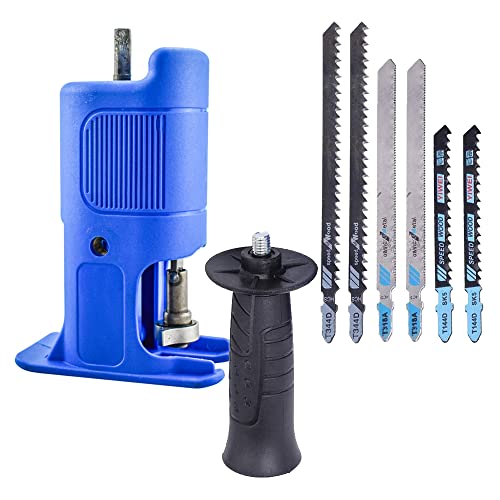 BSEWO Reciprocating Saw Adapter Drill Attachment |
8.3/10 | Buy |
 Metabo HPT 18V Cordless One-Handed Reciprocating |
7.8/10 | Buy |
Metabo HPT 36V MultiVolt Cordless Reciprocating
The Metabo HPT CR36DA 36V MultiVolt reciprocating saw kit pairs a high-output brushless motor with a 1-1/4-inch stroke length and orbital cutting mode for demanding demolition and framing tasks. It is an ideal cutting tool for general contractors, remodelers, and plumbers seeking serious demolition speed with low vibration.
Pros
- Long 1-1/4-inch stroke length and up to 3,000 SPM maximize material removal during aggressive demolition cuts
- Dual counterweight User Vibration Protection (UVP) noticeably reduces reciprocating hand and arm strain
- Brushless 36V motor with 4-stage electronic speed control matches cutting speed to wood, metal, or plastics
- MultiVolt technology supports cordless battery power or continuous corded AC power via a separate adapter
- Comes ready to work with a rapid charger, MultiVolt battery, curved wood blade, and carrying bag
Cons
- At an 8.4-pound listed weight, overhead cutting can cause fatigue during extended continuous use
- The MultiVolt AC wall adapter must be purchased separately if corded hybrid operation is required
- Battery warranty coverage is limited to 1 year compared to the lifetime warranty on the tool body
BSEWO Reciprocating Saw Adapter Drill Attachment
The BSEWO Reciprocating Saw Adapter converts a standard power drill into a compact reciprocating saw for quick branch trimming and PVC cuts. It serves as an economical, space-saving solution for homeowners and DIYers who need occasional rough cutting without buying a dedicated demolition saw.
Pros
- Affordable conversion accessory that utilizes your existing power drill
- Auxiliary handle provides improved hand placement and tool stability
- Comes bundled with replacement blades suited for wood and PVC cutting
- Compact, lightweight footprint stores easily in tight spaces
Cons
- Cutting speed, stroke rate, and torque depend entirely on the host drill motor
- Lacks the heavy internal counterbalancing found on dedicated reciprocating saws
- Not designed for structural framing lumber, heavy demolition, or thick metals
Metabo HPT 18V Cordless One-Handed Reciprocating
The Metabo HPT CR18DAQ4 is a lightweight, one-handed cordless reciprocating saw running up to 3,200 SPM at just 2.9 pounds, engineered with an adaptable clamp that accepts both recip and T-shank jigsaw blades. It is a practical cutting solution for plumbers, electricians, and remodelers needing quick cuts in cramped framing bays.
Pros
- Extremely light 2.9-pound chassis significantly reduces user fatigue during overhead cutting and pipe rough-ins
- Dual-compatibility clamp holds both standard reciprocating blades and fine T-shank jigsaw blades
- High cutting speed up to 3,200 SPM paired with a responsive variable-speed trigger
- Tool-free shoe and blade change mechanisms simplify field adjustments without loose wrenches
- Backed by the Metabo HPT lifetime warranty covering the tool body
Cons
- Bare-tool configuration requires a separate purchase of compatible Metabo HPT 18V or MultiVolt batteries and a charger
- Compact one-handed design is not intended for heavy structural timber demolition or thick cast-iron pipe removal
- Absence of an orbital action mode means heavy wood rough cuts rely entirely on straight reciprocating motion
Frequently Asked Questions
What are the main differences in a reciprocating saw head to head makita vs metabo hpt comparison?
Metabo HPT emphasizes hybrid power versatility with its MultiVolt system, while Makita focuses on dual 18V or 40V max cordless platforms with counterbalance anti-vibration technology. Metabo HPT models allow you to switch between 36V batteries and an AC power adapter for continuous benchtop or jobsite work. Makita tools provide refined motor controls and compact bodies, but Metabo HPT delivers high stroke lengths and user vibration protection at competitive price points.
Does orbital action improve reciprocating saw cutting speed in wood?
Yes, orbital action significantly accelerates cutting speed through dimensional lumber and framing studs. This setting introduces an elliptical blade motion that lifts the teeth slightly on the return stroke, ejecting chips and sawdust rapidly. For cutting heavy metal or steel pipes where blade teeth can snag, switching off the orbital mode produces smoother cuts, much like the straight-line action used on dedicated cold cut metal chopsaws.
How does stroke length affect cutting performance in 2026?
A longer stroke length delivers faster material removal by engaging more blade teeth per cycle. Saws featuring a 1-1/4-inch stroke length power through thick framing timber far quicker than compact saws with a 1/2-inch or 5/8-inch stroke. However, shorter stroke designs give operators tighter control when working inside finished walls, trimming PVC pipes, or slicing thin electrical conduit.
Can a one-handed reciprocating saw handle full-scale framing demolition?
No, one-handed reciprocating saws lack the heavy stroke length and two-handed leverage required for dense framing demolition. Compact one-handed models deliver high speeds around 3,200 strokes per minute, making them ideal for pruning, cutting drywall, or trimming pipes in tight stud bays. Heavy structural tear-outs with embedded nails demand full-size reciprocating saws equipped with higher stroke lengths and dual counterweight systems.
What are the benefits of a 4-stage speed selector on a reciprocating saw?
A 4-stage speed selector lets you dial in the exact stroke rate required for diverse jobsite materials. Lower speeds between 1,700 and 2,000 strokes per minute prevent tooth friction and blade overheating when cutting hard metals or cast iron. High-speed settings up to 3,000 strokes per minute deliver rapid cutting through softwoods, plywood, and standard drywall panels.
Can standard drill reciprocating saw adapters replace dedicated reciprocating saws?
No, drill reciprocating saw adapters serve best as light-duty attachments for occasional household trimming. These converters connect directly to a drill chuck, making them handy for small plastic pipes or thin yard branches. They do not possess the reinforced internal drive mechanisms, extended stroke length, or anti-vibration features found in professional-grade cordless reciprocating tools.
About the author

Doug Mahoney is an experienced home-improvement and tool writer with a professional background in carpentry, jobsite supervision, renovation, and hands-on product evaluation. He has spent years covering tools and outdoor power equipment and brings practical construction experience to product research, helping readers understand performance, usability, durability, and the real-world differences between competing equipment.