
What Is Chain Pitch: Practical Guide for 2026
Learn what is chain pitch and how drive sprocket sizing impacts cutting efficiency for October 2026. Match chain pitch to your guide bar safely.
 By Tony Flanders
Updated October 2, 2026
By Tony Flanders
Updated October 2, 2026
Selecting the correct cutting loop for a chainsaw requires matching several mechanical tolerances that dictate how the chain engages the drive sprocket and guide bar. Many woodcutters encounter sudden engine bogging, excessive cutting chatter, or thrown chains simply because they do not understand what is chain pitch before ordering a replacement loop. Chain pitch directly determines the distance between individual drive links, which must synchronize cleanly with the teeth on the drive rim or spur sprocket. Operating an unmatched pitch causes immediate drive system binding, accelerated sprocket wear, and severe safety hazards along the guide bar rails. For small trimming jobs around residential yards, property owners often alternate between motorized powerheads and dedicated pruning saws for garden upkeep to handle lighter branch clearing safely.
Beyond matching the drive sprocket, chain pitch governs chip clearance capacity and the amount of engine power required to pull the cutters through timber. Small displacement gasoline engines and cordless battery saws typically rely on narrower, low profile pitches to reduce cutting drag, while larger farm and commercial saws use broader pitches to clear sizable wood chips in deep cuts. Understanding chain pitch alongside gauge and drive link count prevents costly mechanical mismatches on the workbench. Checking the manufacturer specifications stamped on the guide bar tail ensures your saw maintains proper cutting speed without overloading the powerhead.
| Award | Product | TGH Score About TGH ScoreThe TGH Score is our own rating from 0 to 10, based on performance, design and build, ease of use, and value. It reflects independent research and is never influenced by manufacturers, retailers, or affiliate commissions. Learn more › | |
|---|---|---|---|
| Best Overall |
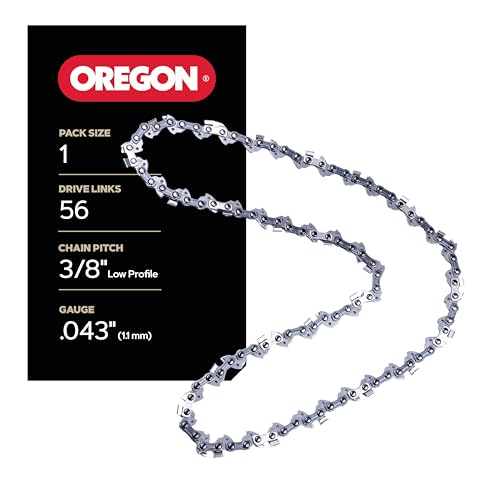
Oregon Chainsaw Chain for 16" Bar, 3/8" LP
|
9.1/10 | Buy |
 KAKEI 18 Inch Chainsaw Chain 3/8" LP Pitch .050"
|
8.9/10 | Buy | |
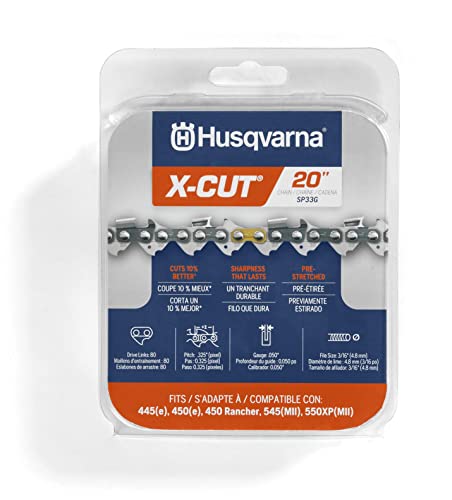 Husqvarna X-Cut SP33G 20 Inch Chainsaw Chain
|
8.4/10 | Buy |
Technical Breakdown of Chain Pitch and Guide Bar Fit
Chain pitch is the physical distance between consecutive drive links, calculated by measuring the distance between any three consecutive rivets and dividing that number by two. This measurement determines the spacing of the drive tangs that drop into the guide bar groove and seat into the drive sprocket. If the pitch of the saw chain does not match both the drive sprocket and the nose sprocket of the guide bar, the assembly cannot rotate freely. Understanding this measurement is the first step in maintaining smooth woodchip extraction, preventing binding, and ensuring operator safety during cutting tasks.
The Mathematical and Mechanical Definition of Pitch
A saw chain consists of drive links, tie straps, and cutting teeth connected by steel rivets. Because drive links alternate with connection links, measuring distance from one rivet to the next yields varying spacing across different sections. To establish a standardized measurement, manufacturers measure across three consecutive rivets from their exact centerpoints and divide that distance by two. This calculation produces the true pitch specification, representing the centerline distance between the drive tangs that engage the drive sprocket.
Chainsaw chain pitch is expressed as a fraction or a three-digit decimal number. For example, a chain measuring 0.75 inches across three pins has a pitch of 3/8 inch, which equals 0.375 inches. A chain measuring 0.65 inches across three pins yields a .325-inch pitch specification. Because these measurements differ by mere thousandths of an inch, visual estimation alone cannot determine chain pitch reliably.
Common Pitch Sizes: From 1/4 Inch to .404 Inch
Modern powered saws utilize several standardized chain pitch sizes designed for specific equipment platforms. The 1/4-inch pitch represents a compact format frequently installed on pole pruners, mini battery saws, and precision carving bars. Stepping up in scale, 3/8-inch Low Profile, commonly abbreviated as 3/8 LP, provides an efficient cutting footprint tailored for lightweight consumer saws. For light yard clearing, some landowners prefer balancing power equipment with manual hand saws for cutting limbs when managing tight canopy spaces where powered saws prove cumbersome.
Mid-range homeowner and ranch saws typically transition to .325-inch pitch, balancing cutting speed with chain durability in mixed timber. Professional forestry powerheads operating between 50cc and 90cc usually run standard 3/8-inch chain with large cutting teeth capable of clearing heavy chips. Heavy-duty timber felling operations step up to .404-inch pitch, which incorporates thick steel chassis parts designed to withstand high torque from engines displacing 90cc or more.
Low Profile 3/8 Inch Versus Standard 3/8 Inch Chains
One frequent point of confusion among chainsaw owners involves the distinction between 3/8-inch Low Profile and standard 3/8-inch pitch. Although both chains share the same theoretical pitch measurement of 0.375 inches between rivets, their chassis profiles differ significantly. Low Profile chains feature a shorter cutter height and shallower tie strap profile designed for smaller guide bars and lighter engines. Standard 3/8-inch chains utilize a much taller chassis and heavier cutting teeth that require substantial powerhead torque to pull through hardwood.
Because drive tang and chassis dimensions vary, 3/8-inch Low Profile chains cannot be mounted on standard 3/8-inch drive sprockets or guide bars. Fitting a standard 3/8-inch chain onto a low-profile guide bar causes drive links to bottom out or jam inside the rail groove. Conversely, running a low-profile chain across a heavy standard 3/8-inch drive rim leads to severe mechanical slop, rapid sprocket wear, and thrown chains. Operators must always verify whether their saw specifies standard 3/8-inch or 3/8-inch Low Profile components before buying replacements.
How Pitch Interacts with Drive Sprockets and Bar Nose Sprockets
The drive sprocket on your chainsaw powerhead features pockets that match the drive link tang spacing dictated by the chain pitch. Powerheads utilize either a solid spur sprocket welded to the clutch drum or a floating rim sprocket on a splined hub. When chain pitch matches sprocket spacing, each drive link nests smoothly into the gullet, transferring rotational energy without friction. If the pitch differs even slightly, the drive links ride high on the teeth, creating extreme rivet stress and violent binding.
Guide bars equipped with a sprocket nose introduce a second critical alignment point for chain pitch. The small gear wheel embedded in the bar nose supports the cutting loop through the turn, reducing rail friction and heat. This nose sprocket has a tooth pitch that must match the chain and the drive sprocket exactly. Installing an unmatched pitch will cause drive links to wedge against nose sprocket teeth, quickly destroying the nose bearings and locking the chain in the cut.
Matching Chain Pitch to Engine Displacement and Battery Voltage
Chainsaw manufacturers select chain pitch based on motor torque output and rotational speed. Small two-stroke gasoline engines displacing up to 42cc, as well as cordless battery platforms operating at 36V, 40V, or 56V, commonly rely on 3/8-inch Low Profile loops. For example, the Oregon Chainsaw Chain for 16″ Bar, 3/8″ LP is specifically designated for chainsaws up to 42cc, providing low-drag cutting for platforms such as Makita, DeWalt, Ego, Greenworks, and Milwaukee. These smaller powerheads lack the torque required to drive large cutters without bogging down, making low-profile chains essential for maintaining chain speed.
Mid-sized powerheads ranging from 45cc to 60cc provide the torque necessary to pull .325-inch pitch cutting chains efficiently through dense wood. A prime example is the Husqvarna X-Cut SP33G 20 Inch Chainsaw Chain, which uses a .325-inch pitch and .050-inch gauge configuration engineered for saws like the Husqvarna 450 Rancher, 445, and 550XP. The closer tooth spacing of .325-inch pitch delivers smooth cutting action with minimal kickback chatter, making it ideal for farm bucking. Saws displacing over 65cc step up to standard 3/8-inch chain because the engine produces sufficient power to exploit larger cutter teeth for aggressive timber felling.
The Critical Triad: Pitch, Gauge, and Drive Link Count
While understanding chain pitch is fundamental, pitch alone does not provide enough information to select a replacement saw chain. Every chainsaw loop requires three matching parameters known as pitch, gauge, and drive link count. Gauge refers to the thickness of the drive link tangs traveling inside the guide bar slot, with common measurements including .043 inch, .050 inch, .058 inch, and .063 inch. A chain with the correct pitch will fail if the gauge is too thick to fit into the bar rails or too thin, causing the chain to wobble and cut crooked kerfs.
Drive link count specifies the total number of drive tangs around the entire circumference of the cutting loop. This count dictates physical chain length and must match the guide bar length and motor mount pattern. For example, the KAKEI 18 Inch Chainsaw Chain 3/8″ LP Pitch .050″ specifies 62 drive links, whereas a different 18-inch bar might require 60 or 64 links depending on tail geometry. Purchasing a chain based strictly on nominal bar length without verifying pitch, gauge, and drive link count almost always leads to a chain that cannot be tensioned properly.
Locating Stamped Specifications on Guide Bars
Chainsaw operators do not need precision calipers to identify cutting loop parameters before servicing equipment. Guide bar manufacturers stamp pitch, gauge, drive link count, and bar length directly into the metal near the motor mount tail. Removing the clutch cover and wiping away bar oil and sawdust reveals alphanumeric markings identifying the exact chain configuration. A typical bar stamp might read 3/8 LP, .050, 62DL, instantly communicating that the bar requires a 3/8-inch low-profile pitch, a .050-inch gauge, and a 62-link loop.
If guide bar markings have worn away from years of friction against wood, operators can check the powerhead manual or count drive links manually. To count drive links by hand, mark one drive tang with chalk and count each tang around the loop until returning to the start. Chain pitch can be confirmed by checking the part number stamped on the drive sprocket or consulting the manufacturer parts breakdown. Locating these stamped specifications eliminates guesswork and ensures that every replacement component matches factory tolerances.
Cutter Profiles, Vibration, and Low-Kickback Safety Standards
Chain pitch also influences the cutting tooth design and safety geometry engineered into modern saw loops. Chains are typically ground with either semi-chisel or full-chisel cutter teeth, each offering distinct advantages depending on timber cleanliness. Semi-chisel teeth feature rounded working corners that retain sharpness longer when cutting dirty firewood, frozen logs, or abrasive bark. Loops like the KAKEI 18 Inch Chainsaw Chain 3/8″ LP Pitch .050″ utilize semi-chisel cutters engineered to balance edge retention with steady cutting speeds across diverse property maintenance tasks.
Safety standards established by ANSI B175.1-2012 and CSA Standard Z62.3 dictate kickback performance criteria for consumer chainsaw loops. Low-kickback chains incorporate ramped depth gauges and bumper drive links positioned directly ahead of the cutting teeth. For instance, the Oregon Chainsaw Chain for 16″ Bar, 3/8″ LP integrates bumper drive links that redirect wood fibers upward, preventing the cutter from snagging abruptly in the upper quadrant of the bar nose. These safety features reduce violent reactive forces while allowing the chain pitch to deliver predictable, controlled cutting progress through seasoned timber.
Sharpening Considerations: Matching Round File Diameters to Pitch
Maintaining a sharp cutting chain requires matching round sharpening file diameter directly to chain pitch. Because each pitch size features cutting teeth of differing heights and radius curves, using the wrong file diameter alters the tooth cutting angle and hook geometry. A 3/8-inch Low Profile chain requires a 5/32-inch (4.0 mm) round file to create the proper concave gullet on the cutter face. In contrast, a .325-inch pitch chain requires a 3/16-inch (4.8 mm) file, while standard 3/8-inch chain demands a 7/32-inch (5.5 mm) or 13/64-inch file to restore the edge correctly.
Alongside cutter tooth sharpening, operators must periodically adjust the depth gauges, commonly referred to as rakers, located in front of each cutter. Depth gauges regulate how deep the cutter tooth bites into the wood grain during each revolution around the guide bar. If depth gauges remain too high after repeated tooth sharpenings, the chain produces fine dust and refuses to self-feed into the wood. Filing depth gauges with a flat file and a progressive depth gauge tool calibrated to 0.025 inch maintains optimum chip production without causing dangerous chain grabbing.
Field Symptoms of Pitch Mismatch and Sprocket Wear
Operating a chainsaw with an incorrectly matched chain pitch produces unmistakable mechanical warning signs that demand immediate shutdown. If a .325-inch chain is forced onto a 3/8-inch drive sprocket, the chain resists manual rotation around the bar rails and feels stiff even with the tensioning screw backed off. Under engine power, a mismatched chain clatters loudly as drive tangs strike sprocket teeth out of synchronization, causing rapid chipping of drive links. Continued operation chews deep grooves into the sprocket face and overheats the guide bar nose sprocket bearings.
Even when pitch sizes match initially, powerhead drive sprockets naturally wear out after pulling multiple cutting loops through heavy timber. When sprocket tooth pockets wear past 0.020 inch in depth, the effective pitch diameter changes, preventing new chains from seating evenly. Operators should inspect the drive sprocket every time they replace a worn chain loop, looking for stepped wear ridges or burred teeth. Replacing the drive sprocket alongside every two to three chain replacements preserves chain life and ensures that pitch geometry remains properly aligned during heavy bucking.
Selecting Replacement Loops for Property Care and Firewood Bucking
When preparing to purchase replacement chains for firewood processing or storm cleanup, matching chain pitch directly to your operating routine saves time and equipment wear. Many modern replacement loops arrive factory pre-stretched, helping minimize initial chain slack during the first heat cycle. The Husqvarna X-Cut SP33G 20 Inch Chainsaw Chain incorporates pre-stretched manufacturing processes and refined lubrication channels designed to keep oil flowing directly to the rivet joints. Choosing pre-stretched loops reduces the frequency of bar nut adjustments needed during cold mornings on the woodpile.
Always verify your guide bar tail stamp for pitch, gauge, and drive link count before securing your next cutting loop. Once installed, confirm proper tension by pulling the chain along the bottom rail by gloved hand with the chain brake released to ensure free rotation. Taking the time to understand chain pitch guarantees that your saw powerhead, drive sprocket, and guide bar work together as a balanced cutting system. This mechanical harmony maximizes cutting efficiency, protects your equipment investment, and keeps your woodcutting tasks productive and safe.
About the author
Tony Flanders is an experienced astronomy writer and observer with a background in mathematics, technical research, and science communication. His extensive observing experience includes exploring deep-sky objects through different telescope configurations. He specializes in making complex astronomical concepts accessible to beginners and experienced observers alike.