
Which Jigsaw Blade for Wood: Practical Woodworking Guide for 2026
Which Jigsaw Blade For Wood selection guide for November 2026. Learn how tooth count, pitch direction, and bi-metal construction deliver splinter-free wood cuts.
 By Bradley Ford
Updated October 13, 2026

Ripping through a dense plank of red oak only to find jagged tear-out and an angled, beveled edge can ruin an entire woodworking project in seconds. Handheld jigsaws offer unmatched flexibility for intricate curves and interior cutouts, but their performance depends almost entirely on selecting the right cutting accessory for the specific timber species. Determining which jigsaw blade for wood suits your immediate task requires balancing tooth geometry, blade thickness, and metallurgical construction against material density. While stationary shop equipment like a table saw or a dedicated cordless bandsaw for clean workshop cuts handles repetitive straight lines with ease, a handheld jigsaw paired with the right blade provides portable precision across finished plywood, composites, and solid lumber.
Different cutting tasks demand vastly different tooth configurations, ranging from aggressive low tooth counts for rapid dimensioning to ultra-fine reverse teeth designed to protect delicate face veneers. Using an improper blade often results in severe top-surface splintering, scorching along the kerf line, or excessive blade wander under heavy feed pressure. Modern blade innovations, including specialized bi-metal teeth and reinforced beam designs from brands like Bosch and Diablo, help control deflection while maintaining clean surfaces on both faces of the board. Understanding how tooth pitch, shank geometry, and orbital action interact allows woodworkers and carpenters to achieve repeatable, splinter-free results on every cut.
| Award | Product | TGH Score About TGH ScoreThe TGH Score is our own rating from 0 to 10, based on performance, design and build, ease of use, and value. It reflects independent research and is never influenced by manufacturers, retailers, or affiliate commissions. Learn more › | |
|---|---|---|---|
| Best Overall |
Diablo 4-5/8-Inch Bi-Metal Jig Saw Blades 5-Pack
|
9.2/10 | Buy |
| Best Value |
 Bosch T307BFP 4-1/2-Inch 12 TPI Precision Hardwood |
9.1/10 | Buy |
| Best Premium |
 Bosch T5002A 10-Piece T-Shank Blade Set |
9.1/10 | Buy |
| Best Budget |
 OSVJE 14-Piece U-Shank Jigsaw Blade Set for Wood |
8.8/10 | Buy |
 Romeda 10-Piece T-Shank Jigsaw Blade Set |
8.4/10 | Buy | |
 BerryBoi T142HB T-Shank Jigsaw Blades 6-Pack |
8.3/10 | Buy | |
 MRCGTCE 50-Piece T-Shank Jigsaw Blade Set |
8.1/10 | Buy | |
 Craluuur 30-Piece T-Shank Jigsaw Blade Set |
8.0/10 | Buy |
Diablo 4-5/8-Inch Bi-Metal Jig Saw Blades 5-Pack
Diablo bi-metal jigsaw blades feature opposing teeth designed to leave clean surfaces on both the top and bottom of wood cuts. This 5-pack offers extended edge life for finish carpenters and woodworkers tackling pre-finished sheet goods and delicate trim.
Pros
- Dual-directional teeth help prevent splintering on both the face and underside of workpieces
- Ultra-hardened bi-metal construction provides noticeable longevity advantages over basic carbon steel blades
- Versatile 4-5/8-inch length handles standard interior joinery and sheet goods
- Compatible with a wide range of combo and U-shank jigsaw blade clamping mechanisms
Cons
- Opposing tooth geometry requires steady downward shoe pressure to prevent saw chatter or jumping
- Fine tooth pitch cuts slower in thick stock compared to aggressive, low-TPI rough-cutting blades
- Designed specifically for wood applications and not suitable for nail-embedded lumber or metal cutting
Bosch T307BFP 4-1/2-Inch 12 TPI Precision Hardwood
The Bosch T307BFP 3-piece jigsaw blade set provides 12 TPI precision cutting designed to deliver right-angle, splinter-free cuts on both faces of dense hardwoods. It is a dependable choice for cabinetmakers, trim carpenters, and serious DIYers tackling delicate curves and visible finish cuts.
Pros
- Produces clean, splinter-free edges on both the top and bottom faces of dense hardwood stock
- Engineered to resist blade deflection, supporting square right-angle cutlines during curve work
- Standard T-shank design provides seamless compatibility with tool-free clamps on major jigsaw platforms
- 12 TPI configuration offers an effective balance of cutting control and smooth surface finish
Cons
- Fine 12 TPI pitch produces slower cutting speeds compared to coarse, aggressive roughing blades
- Designed strictly for wood and abrasive woodworking composites, not for metals or demolition work
- Pack contains three blades, which may require frequent restocking on larger cabinet production runs
Bosch T5002A 10-Piece T-Shank Blade Set
This 10-piece assortment supplies a versatile mix of blades for clean cuts, fast cuts, and scrolling across wood and metals. Housed in a durable plastic case, it offers a well-rounded starter or replacement kit for everyday cutting tasks.
Pros
- Versatile mix for straight, fast, and curved cuts
- Works across wood, ferrous, and non-ferrous metals
- Protective plastic case keeps blades organized
- Standard T-shank connection provides wide tool compatibility
Cons
- Includes only two blades per cut profile
- Not compatible with jig saws requiring U-shank blades
OSVJE 14-Piece U-Shank Jigsaw Blade Set for Wood
The OSVJE 14-Piece U-Shank Jigsaw Blade Set offers a versatile assortment of high-carbon steel blades ranging from 6 TPI to 32 TPI for wood, plastic, and non-ferrous metal cutting. It is a practical, budget-conscious choice for homeowners and DIYers maintaining jigsaws with standard U-shank clamping systems.
Pros
- Broad tooth count variety from 6 TPI to 32 TPI covers multiple material types
- High-carbon steel provides flexible, durable performance for general DIY and hobby use
- Provides duplicate pairs for all seven blade variations in one affordable package
- Reliable fit for older and traditional jigsaws using U-shank blade clamps
Cons
- U-shank tang design is not compatible with modern jigsaws that require standard T-shank blades
- High-carbon steel wears faster in dense hardwoods and thick steel than bi-metal or carbide alternatives
- Does not include an indexed plastic storage case for organizing loose blades
Romeda 10-Piece T-Shank Jigsaw Blade Set
The Romeda 10-piece assortment provides a practical selection of SK5 high carbon steel T-shank jigsaw blades designed for clean wood cuts, rapid roughing, and light metal work. It serves as an accessible replacement kit for DIYers, weekend hobbyists, and homeowners seeking versatile cutting options on a budget.
Pros
- Versatile 10-piece assortment covers fine finish, fast roughing, tight curved, and light metal cuts
- Universal T-shank design installs quickly in tool-free jigsaw clamps without set screws
- SK5 high carbon steel offers solid durability for softwoods, composites, and PVC
- Includes specialized reverse-tooth (T101BR) and scroll-cutting (T244D) blade profiles
Cons
- High carbon steel construction wears faster in thick steel or dense hardwoods compared to bi-metal or carbide blades
- Ships in simple packaging without a rigid, labeled storage case for workshop organization
- Single-blade counts per profile mean high-volume cutting tasks will require frequent replacement
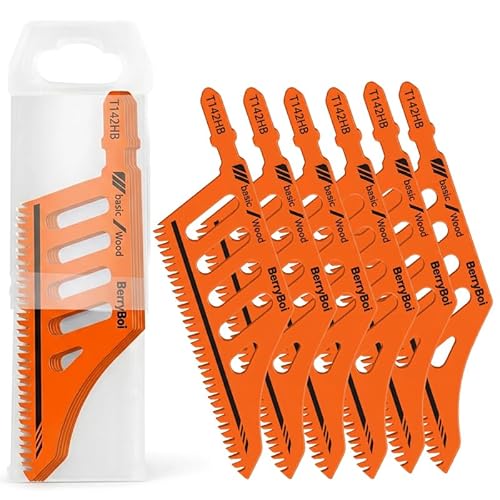
BerryBoi T142HB T-Shank Jigsaw Blades 6-Pack
The BerryBoi T142HB 6-pack provides high carbon steel T-shank jigsaw blades with a specialized body profile designed for flush cuts, edge trimming, and tight curve work. It offers an affordable, reliable cutting solution for DIYers, finish carpenters, and remodelers managing detail cuts in confined spaces.
Pros
- Specialized flush-cut blade profile allows trimming close to adjoining edges and interior corners
- Universal T-shank design slots smoothly into tool-free jigsaw clamps across major power tool brands
- Protective black coating over high carbon steel reduces cutting friction and resin buildup
- Affordable six-blade pack provides dependable backups for everyday woodworking and plastic fabrication
Cons
- High carbon steel construction is limited to softer materials and is unsuitable for cutting metal or nail-embedded wood
- Special-shaped thin body requires moderate feed pressure to avoid blade deflection during sharp radius cuts
- Single-model pack lacks tooth-pitch variety for users seeking a multi-purpose assortment
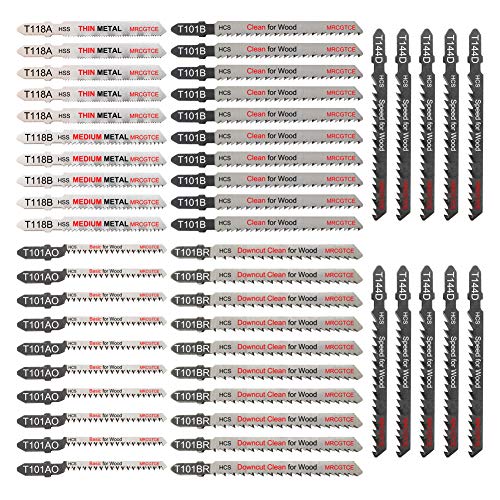
MRCGTCE 50-Piece T-Shank Jigsaw Blade Set
This 50-piece assorted T-shank jigsaw blade set delivers versatile cutting profiles for wood, plastic, and metal within an organized hardshell storage case. It offers tremendous utility and cost-effective value for remodelers, trim carpenters, and DIY workshop builders.
Pros
- Expansive 50-piece variety covers rough framing, fine finish carpentry, tight curves, and thin metal cutting
- Standard T-shank tang configuration fits tool-free clamps on major jigsaw brands
- Includes specialized blade geometries like reverse-tooth and narrow scrolling profiles
- Durable organized case prevents blades from tangling and dulling during transit
- High value-to-cost ratio compared to purchasing individual retail multi-packs
Cons
- High-volume stamped steel blades may wear faster in dense hardwoods or abrasive metals than premium carbide-tipped alternatives
- Blade identification stampings may fade or wear under heavy friction during extended cutting sessions
- The large selection may provide more specialized metal or scroll blades than casual DIYers require for simple straight cuts
Craluuur 30-Piece T-Shank Jigsaw Blade Set
This comprehensive 30-piece assortment equips standard T-shank jigsaws with nine distinct blade patterns for wood, metal, and plastic. Constructed from high-carbon and high-speed steel, it is a practical multi-material blade kit for everyday workshop tasks.
Pros
- Broad 9-type selection for varied materials
- Standard T-shank design fits most modern jigsaws
- Includes labeled shanks for fast identification
- Comes with a dedicated storage case
Cons
- Not compatible with U-shank jigsaw models
- Metal blades limited to basic cutting tasks
Matching Jigsaw Blades to Woodwork Applications and Material Profiles
Choosing the correct jigsaw blade for wood depends on whether your project prioritizes cutting speed, edge cleanliness, or tight radius maneuverability. Fast rough cuts in construction lumber require coarse blades with 6 to 8 teeth per inch, while clean cuts in pre-finished plywood and hardwood demand finer profiles with 10 to 12 teeth per inch or reverse-pitch teeth. Matching the blade metallurgy and shank interface to your saw ensures stable performance without premature tooth wear or chuck slippage.
Tooth Count Dynamics and Matching TPI to Material Thickness
Teeth per inch (TPI) dictates the balance between aggressive material removal and cut surface cleanliness. Coarse blades featuring 6 TPI to 8 TPI, such as the common T144D pattern, feature large gullets that efficiently evacuate sawdust from thick softwood framing and construction panels. These aggressive teeth tear through material quickly because each tooth takes a substantial bite on the upstroke. However, this aggressive cutting action naturally leaves splintered edges on the top surface of the board, making low TPI blades unsuitable for finished cabinetry or veneer panels.
Finer blades equipped with 10 TPI to 12 TPI, such as the T101B or Diablo 12 TPI bi-metal blades, produce noticeably smoother edges with significantly less chip-out. A higher tooth count distributes cutting forces across multiple contact points, which reduces vibration and yields a polished cut face in dense lumber. The rule of thumb for clean cutting requires keeping at least two to three teeth engaged in the workpiece thickness at all times. Thin sheet goods and delicate veneers benefit substantially from fine-tooth configurations because smaller teeth prevent individual wood fibers from lifting and snapping.
High-Carbon Steel Versus Bi-Metal and Specialized Coatings
Blade composition directly influences edge retention, lateral flexibility, and overall service life when cutting abrasive materials. Standard high-carbon steel blades, frequently crafted from SK5 steel in budget assortments from Romeda and OSVJE, offer excellent flexibility and adequate sharpness for softwoods like pine, cedar, and spruce. Because high-carbon steel is relatively ductile, these blades absorb minor bending stresses without immediately snapping during curved passes. However, dense hardwoods and adhesive-heavy composite boards quickly dull carbon steel cutting edges through frictional heat.
Bi-metal blades fuse a tough high-speed steel tooth strip to a flexible carbon-steel backing body, creating a durable tool that resists thermal breakdown. Premium options like the Diablo bi-metal series or Bosch T307BFP precision blades maintain their edge sharpness significantly longer in abrasive materials such as white oak, hard maple, and dense fiberboard. Specialized surface coatings, such as black friction-reducing treatments found on BerryBoi T142HB blades, further decrease operating temperatures during prolonged cuts. Investing in bi-metal construction proves essential when cutting glued laminates, marine plywood, or dense hardwoods where standard carbon teeth overheat and scorch the wood fibers.
Standard Up-Cut Versus Reverse-Pitch Tooth Configurations
Standard jigsaw blades feature teeth that point upward toward the tool body, cutting exclusively on the upward reciprocating stroke. This upward cutting motion pulls the saw baseplate firmly down against the workpiece surface, ensuring stability and preventing the tool from chattering or jumping. The unavoidable drawback of standard up-cut blades is tear-out on the upper face of the board, as the ascending teeth push wood fibers upward into unsupported air. While this top-surface splintering is completely acceptable on rough framing or when cutting from the backside of the board, it ruins finished countertops and cabinet components.
Reverse-pitch blades, designated with an “R” suffix such as the T101BR, solve top-face tear-out by orienting their teeth downward toward the work table. Down-cutting teeth slice cleanly through surface veneers without lifting the delicate top layer, preserving crisp edges on pre-finished plywood and laminate surfaces. Operating a reverse-pitch blade requires firm, steady downward pressure on the jigsaw handle because the downward stroke pushes the tool away from the workpiece. Hybrid dual-directional designs, such as the Diablo bi-metal blade with opposing teeth at each end, address this dynamic by shearing fibers cleanly from both top and bottom edges simultaneously.
Shank Compatibility Standards: Modern T-Shank Versus Legacy U-Shank
Jigsaw blades connect to the reciprocating drive mechanism through one of two distinct interfaces: the industry-standard T-shank tang or the older U-shank design. T-shank blades feature a cross-shaped shoulder that locks directly into modern tool-free chuck mechanisms without requiring hex wrenches or screwdrivers. This standard format provides robust clamping pressure and allows instant, spring-loaded blade ejection, preventing woodworkers from burning their fingers when removing scorching hot blades after a long cut. Blade sets like the Bosch T5002A and MRCGTCE contractor pack utilize this ubiquitous mounting style.
Universal U-shank blades, represented in kits like the OSVJE 14-piece set, feature a rounded notch at the mounting tip designed to fit older screw-clamp jigsaws. While certain contemporary saws feature combo clamps capable of gripping both shank types, dedicated tool-free chucks generally deliver far superior holding power with T-shank accessories. Attempting to force a U-shank blade into a dedicated T-shank quick-release mechanism can result in loose seating, severe blade wobble, or sudden ejection under load. Checking your saw manual before purchasing ensures proper chuck engagement and prevents dangerous slippage during operation.
Managing Lateral Deflection and Maintaining True Right-Angle Cuts
Blade deflection represents the most frustrating obstacle when attempting to achieve square, 90-degree cut edges in thick lumber. Because a jigsaw blade is supported only at the top chuck, the bottom tip can wander laterally when side pressure is applied during turns or through uneven grain. Dense hardwood growth rings can deflect flexible, thin-gauge blades off course, producing a beveled edge even when the saw shoe is calibrated perfectly flat. Thicker precision blades, like the Bosch T307BFP precision hardwood blade, incorporate extra beam width and conical ground bodies to resist lateral bending in stock up to 1.5 inches thick.
Preventing blade deflection requires letting the saw teeth do the cutting without forcing excessive forward feed pressure. Pushing too hard against the wood grain causes the thin blade body to bow backward, forcing the tip to wander away from the vertical cutting axis. Proper alignment of the saw roller guide bearing also plays a pivotal role by supporting the blade spine directly behind the teeth. Woodworkers should inspect the roller guide to ensure the blade sits snugly inside the center groove without binding or tilting sideways during reciprocation.
Scroll Blades Versus Standard Profiles for Tight Radii
Cutting intricate curves, scrollwork, and tight circular cutouts requires a narrow blade profile specifically designed for multidirectional maneuvering. Standard wood-cutting blades feature a broad body width from tooth tip to spine, which provides excellent tracking stability for straight lines but binds against the kerf wall during sharp radius turns. Attempting to force a wide blade like a T144D through a tight circle creates intense friction, scorching the wood and frequently snapping the blade near the chuck.
Dedicated scroll blades, such as the narrow-bodied T101AO or T119BO found in the Bosch and Craluuur assortments, measure roughly half the width of general-purpose blades. This narrow beam profile allows the blade to pivot smoothly inside the cut kerf without binding against the side walls. Scroll blades often incorporate pointed, ground teeth that cut on both the forward and backward arcs of tight turns, enabling clean decorative fretwork and sink corner transitions. When cutting tight radiuses, operating the saw at moderate stroke speeds prevents friction buildup and keeps the cutline clearly visible.
Calibrating Orbital Action Settings with Blade Profiles
Orbital action introduces an elliptical pendulum motion to the jigsaw stroke, thrusting the blade forward into the cut on the upstroke and pulling it back on the downstroke. This motion dramatically accelerates chip clearance and increases cutting speed through softwoods when combined with aggressive coarse blades. Most modern jigsaws offer orbital settings from 0 to 3, allowing woodworkers to tailor the stroke geometry to their specific material. Engaging maximum orbital action on setting 3 works exceptionally well for rough framing cuts where raw speed outweighs edge appearance.
Orbital action must be dialed down to setting 0 or 1 when using fine-tooth, reverse-pitch, or scroll blades on delicate hardwoods and veneers. An aggressive orbital swing negates the clean-shearing benefit of fine teeth, lifting surface fibers violently and generating severe top-side tear-out. Furthermore, orbital movement can cause narrow scroll blades to jump off their guide rollers during tight radius steering. For clean furniture components, laminate sink cutouts, and dense hardwoods, restricting the saw to a straight vertical reciprocation at setting 0 delivers the squarest and cleanest results.
Workpiece Preparation and Starter Hole Techniques for Interior Cutouts
Interior cutouts, such as sink basin openings in butcher block countertops or electrical access ports in cabinet backs, present unique starting challenges. While some experienced operators plunge cut directly into soft materials by tilting the saw forward on its shoe toe, plunge cutting into thick hardwood carries a high risk of tool kickback and blade bending. A safer and far more controlled method involves boring a starter pilot hole inside the waste area adjacent to your marked cutline. Drilling this starter hole allows the blade to insert freely into the cut without placing violent shock loads on the chuck mechanism.
Preparing clean starter holes is simple when using a capable drill, such as pairing your layout with a heavy-duty brushless drill for starter pilot holes and a sharp spade or Forstner bit. Sizing the hole slightly larger than your jigsaw blade width ensures that the saw baseplate rests completely flat before you engage the motor trigger. Applying low-tack painter tape along the cut perimeter provides an extra layer of protection against shoe scuffing and fiber splintering. Once the saw reaches full operating speed inside the pilot hole, feed smoothly into the marked layout line without rushing the corner transitions.
Blade Selection Summary and Post-Cut Verification
Verifying your cut quality on scrap offcuts before making critical cuts in expensive project lumber prevents costly woodworking mistakes. Check the squareness of test cuts using an accurate engineer square placed against the finished face to confirm that the blade traveled at a true 90-degree angle. If the cut edge reveals a noticeable bevel, reduce your forward feed rate, disengage orbital action, or switch to a stiffer, precision-ground blade body. Inspecting the kerf line for dark burn marks also signals whether the blade has accumulated pitch, dull teeth, or excessive frictional heat.
Matching your wood-cutting jigsaw blade to your specific task transforms a potentially frustrating cutting process into a predictable, high-precision operation. Keep aggressive low-TPI blades reserved for rapid framing and timber breakdown where speed is paramount. Reserve fine-tooth bi-metal blades, reverse-pitch options, and narrow scroll profiles for delicate sheet goods, tight radius curves, and visible finish carpentry. Maintaining sharp, undamaged blades in an organized storage case guarantees consistent cut performance and extends the working life of your power tool.
About the author

Bradley Ford is an experienced hands-on tool tester with a background in farm equipment, welding, mechanical repair, and classic automobiles. His practical experience includes repairing and servicing high-end vehicles as well as testing tools, generators, lawn equipment, and workshop gear. He approaches product evaluation from the perspective of someone who regularly builds, repairs, and maintains equipment.