
What Is a Cordless Electric Snow Shovel: Practical Guide and Tool Overview for 2026
Learn what is a cordless electric snow shovel, how motorized augers throw winter powder, and how battery tools perform in October 2026.
 By Edward Ting
Updated October 2, 2026
By Edward Ting
Updated October 2, 2026

Clearing heavy, saturated snow from steps, walkways, and tight patio corners remains one of the most physically punishing winter chores for any homeowner. Traditional manual shoveling demands repetitive bending, twisting, and lifting that places severe compressive loads on the lumbar spine. Understanding what is a cordless electric snow shovel reveals how modern battery-powered equipment bridges the gap between cumbersome gas-powered snow blowers and manual push scoops. Rather than relying on physical leverage and arm fatigue to throw accumulated powder, these handheld machines utilize a high-speed motorized paddle or auger to propel snow forward and out of the pathway.
Much like selecting tools designed for moving heavy bulk loads during warm-weather landscaping, matching snow equipment to regional snowfall volume requires an eye for build quality and mechanics. A cordless electric snow shovel pairs a rechargeable lithium-ion battery with an ergonomic shaft and a specialized intake housing. This assembly allows operators to glide across flat pavement, wooden decks, and concrete entryways with minimal physical exertion. By replacing the grueling mechanics of deadlifting wet slush with consistent mechanical propulsion, these compact winter implements have reshaped residential snow removal for urban and suburban properties alike.
| Award | Product | TGH Score About TGH ScoreThe TGH Score is our own rating from 0 to 10, based on performance, design and build, ease of use, and value. It reflects independent research and is never influenced by manufacturers, retailers, or affiliate commissions. Learn more › | |
|---|---|---|---|
| Best Overall |
VOLTASK Cordless Snow Shovel, 24V | 13-Inch
|
9.2/10 | Buy |
| Best Budget |
 14" Cordless Snow Shovel w/ 2 Batteries
|
9.1/10 | Buy |
| Best Value |
 Snow Joe Cordless Electric Snow Shovel
|
8.9/10 | Buy |
| Best Premium |
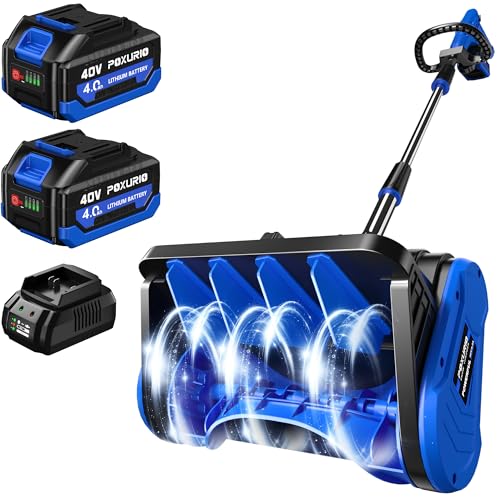 POXURIO 40V Electric Cordless Snow Shovel
|
8.1/10 | Buy |
 EGO Power+ 12" Electric Snow Shovel, Cordless
|
8.1/10 | Buy |
The Mechanics, Engineering, and Practical Utility of Cordless Snow Shovels
A cordless electric snow shovel is a specialized, battery-powered winter maintenance tool designed to propel fresh snowfall away from paved surfaces without manual lifting. Unlike a traditional push shovel that requires direct bodily force to scoop and cast snow, this motorized implement uses a high-speed rotational auger to ingest snow and throw it outward. Homeowners and property caretakers utilize these compact machines to clear driveways, wooden decks, concrete steps, and narrow walkways where large snow blowers cannot easily maneuver.
By housing a dedicated electric motor directly above or within the lower auger housing, the equipment achieves high torque while maintaining an overall lightweight profile. The operator simply guides the intake housing along the ground, allowing the rapidly spinning blades to break apart accumulated drifts and launch them clear of the pathway. This mechanical advantage eliminates the standard spinal compression associated with bending, lifting, and pitching heavy, moisture-laden snow.
Core Anatomy: Electric Motors, Battery Systems, and Paddle Augers
The functional heart of any cordless electric snow shovel consists of an electric motor paired with an intake paddle auger. Modern models generally feature brushless motor technology or heavy-duty copper-wound motors that generate immense rotational velocity while drawing power efficiently from a removable lithium-ion battery. For instance, high-speed paddle augers on compact units can spin at speeds exceeding twenty thousand revolutions per minute, creating substantial centrifugal force to slice through undisturbed snow cover.
Battery platforms range across varying voltage architectures, extending from 20-volt and 24-volt systems up to high-output 40-volt and 56-volt configurations. A higher voltage platform provides increased motor torque, which prevents the auger from bogging down or stalling when meeting dense, hard-packed drifts. Most residential units rely on battery capacities between 2.5 and 5.0 amp-hours, giving users a dependable operational window before requiring a recharge.
Surrounding the rotational auger is a durable polymer housing engineered to funnel snow straight into the blades while shielding the user from flying debris. At the bottom of this housing, a hardened scraper bar glides directly against the pavement to shave snow down to the walking surface. This lower contact edge ensures that minimal residual snow remains behind to form slippery ice patches later in the day.
Clearing Path Dimensions: Width and Depth Capabilities
Clearing dimensions define exactly how much ground a cordless electric snow shovel can process in a single continuous pass. Residential models typically feature clearing widths spanning between 10 inches and 14 inches, making them noticeably narrower than full-sized two-stage snow blowers. This slender profile allows the shovel to fit seamlessly across narrow garden paths, fire escapes, deck stairs, and tight entryways where wider machines cannot fit.
Intake clearing depth generally measures between 5 inches and 8 inches on a single pass, depending on the height of the protective housing. When facing light powder, a ten-inch or twelve-inch machine effortlessly carves a clean channel down to the pavement with minimal forward resistance. If a winter storm deposits twelve inches of accumulation, operators can clear the drift using multiple tiered passes, shaving the top layer before clearing down to the pavement.
Selecting the ideal width balances total clearing speed against physical machine weight. A compact ten-inch unit maneuvers effortlessly on steep steps and tight balconies, but it requires more passes to finish a wide suburban driveway. Conversely, a fourteen-inch machine finishes broad sidewalks significantly faster, though the wider housing adds a small amount of carrying weight during transport and storage.
Snow Ejection Mechanics and Directional Deflector Control
Once the rotating paddle auger grabs the snow, it accelerates the material through centrifugal force and expels it away from the intake housing. Typical cordless electric snow shovels can throw snow anywhere from 18 feet to over 30 feet, depending on motor wattage, auger design, and snow moisture density. Fluffy, dry powder achieves maximum throwing distance, whereas wet, saturated slush exits with a shorter, more concentrated trajectory.
Directional control represents an essential design element that separates basic power shovels from advanced models. Entry-level units often throw snow straight ahead, which requires the operator to angle their body and path to avoid blowing powder into previously cleared walkways. In contrast, advanced models incorporate adjustable directional guide plates or deflector vanes that can pivot 30 to 60 degrees to the left or right.
Having precise control over the ejection stream prevents accidental blowback onto parked vehicles, building siding, or adjacent properties. A simple adjustment lever or turn dial allows the user to aim the discharge chute directly into garden beds or open yard space regardless of walking direction. This targeted discharge ensures that pathways remain tidy without needing repetitive re-clearing of drifted edges.
Cordless Mobility Compared to Gas and Corded Alternatives
Evaluating a cordless electric snow shovel against alternative power equipment highlights immediate functional advantages in portability and convenience. Corded electric shovels provide unlimited runtime, but managing an outdoor-rated extension cord in sub-freezing temperatures poses frustrating handling challenges. Cold cords stiffen, snag against steps, freeze into accumulated slush, and present a persistent tripping hazard across slippery walkways.
Gas-powered single-stage snow blowers provide formidable clearing power, yet they introduce significant maintenance headaches for residential homeowners. Gasoline engines demand regular fuel stabilization, oil changes, spark plug replacements, and exhausting pull-cord starts in freezing conditions. Cordless battery tools eliminate all fuel mixing and exhaust fumes entirely, activating reliably with a simple dual-action push-button safety switch.
Furthermore, battery snow shovels operate with substantially lower acoustic noise compared to internal combustion engines. This quiet operation allows property owners to clear freshly fallen snow early in the morning without disturbing neighbors. The absence of gas fumes also means that these electric tools can be stored safely indoors or inside closets without lingering petroleum odors.
Ergonomics, Weight Distribution, and Spine Safety
Traditional manual snow shoveling places immense shear stress across the lower lumbar vertebrae because lifting snow requires a forward-bent posture paired with a twisting throw. Cordless electric snow shovels fundamentally alter this biomechanical equation by turning snow removal into a forward pushing motion rather than a repetitive lift. Because the spinning auger provides the throwing energy, the operator only needs to supply steady forward momentum.
Most cordless snow shovels weigh between 8 pounds and 14 pounds, creating a tool that is easy to lift, carry, and maneuver across elevated surfaces. Many manufacturers incorporate telescoping shafts that adjust between 47 and 52 inches, allowing users of different heights to work with a neutral, upright spinal posture. Ergonomic auxiliary handles positioned midway down the shaft provide excellent leverage and lateral steering stability without straining the wrists.
To further reduce physical strain and maximize storage convenience, several models feature innovative double-folding or hinged shafts. Once snow clearing is complete, the shaft folds neatly in half, allowing the machine to tuck into a car trunk or hang on a garage tool wall. By keeping physical exertion low and eliminating spinal rotation under load, these tools provide an accessible winter maintenance solution for individuals seeking to protect their back health.
Surface Protection and Deck Preservation
Clearing snow from delicate outdoor surfaces often presents a dilemma when using heavy equipment with sharp metal blades. Steel augers and rigid metal scrapers on conventional snow blowers can easily gouge natural cedar decking, scratch composite boards, or chip decorative stamped concrete. Cordless electric snow shovels solve this problem by incorporating surface-safe contact materials throughout their intake assembly.
The spinning auger blades on these battery tools are typically constructed from high-impact ABS polymers, flexible composite rubber, or cold-resistant alloy plastics. These non-marring materials flex slightly upon contact with minor surface imperfections rather than biting into the substrate. Similarly, the lower scraper bar is usually fabricated from durable, non-abrasive polymers that glide smoothly over wooden plank gaps without catching or splitting the grain.
This gentle contact profile makes cordless power shovels the premier choice for clearing elevated decks, hot tub platforms, and finished porches. Homeowners can thoroughly remove snow down to the wood grain without fearing costly structural damage or ruined paint coatings. Even when clearing uneven flagstone walkways, the polymer intake housing absorbs minor impacts without jarring the operator’s hands.
Sub-Zero Battery Care and Cold-Weather Runtime
Understanding the chemical behavior of lithium-ion batteries in sub-freezing weather is critical for maximizing tool performance and equipment lifespan. Extreme cold slows down the internal chemical reactions within battery cells, temporarily reducing available power output and shortening expected operational runtime. A battery pack that delivers forty minutes of continuous operation in mild weather may yield twenty-five to thirty minutes during a bitter cold snap.
To mitigate cold-weather performance drops, users should always store and charge their battery packs indoors at room temperature prior to use. Bringing a warm battery directly from the house and clicking it into the tool immediately before shoveling preserves optimal voltage and run capacity. Once the shovel is running, the electrical current generated during discharge naturally produces internal warmth, which helps sustain cell efficiency until the job is done.
Many modern kits combat runtime limitations by including dual-battery systems or rapid-charging stations. Running two batteries consecutively allows homeowners to achieve over fifty minutes of total operating time, which is ample duration to clear moderate driveways and extensive walkways. Never attempt to recharge a freezing battery immediately after bringing it indoors; allow the pack to warm to room temperature first to safeguard internal cells.
Comparing Cordless Snow Shovels to Manual Snow Scoops and Pushers
Deciding whether to deploy a battery-powered shovel or a traditional manual shovel depends entirely on snowfall characteristics and physical demands. When breaking ground during summer earthmoving projects, workers rely on shovels built for rocky ground to provide extreme prying rigidity without blade deflection. Similarly, tackling heavy, moisture-saturated snow requires an understanding of how mechanical resistance impacts both the tool and the human body.
Manual push scoops excel at moving lightweight surface powder across broad, unbroken areas, but they force the user to lift and heave every pound once the blade fills. In contrast, an electric shovel actively ejects material continuously, meaning the tool never carries the accumulated dead weight of the snow. This mechanical ejection is especially beneficial when dealing with dense slush that would otherwise stick to manual blade faces and induce severe muscular fatigue.
Much like using shovels designed for heavy clay to slice through dense, cohesive earth, selecting the right snow equipment requires respecting material density limits. While a cordless electric shovel cuts through standard winter precipitation with ease, it is not engineered to act as an ice breaker or a prying lever against solid ice sheets. Attempting to ram the polymer auger into frozen snowbanks can damage the internal drive belt or shear the paddle pins.
Practical Operating Technique for Heavy and Wet Snow
Operating a cordless electric snow shovel effectively involves specific mechanical techniques to prevent motor overload and maximize battery efficiency. When encountering fresh powder up to six inches deep, the operator can maintain a steady, continuous walking pace, pushing the intake housing directly forward along the pavement. The rotational momentum of the paddle will ingest and throw the snow cleanly without hesitation or stalling.
When managing heavy, wet snow or dense slush, slow down the forward pace to allow the high-speed motor to clear the intake chamber completely. If the snowpack exceeds the intake depth of the housing, approach the drift in stratified horizontal layers. Hold the machine slightly off the ground by its dual handles to shave off the top three or four inches, then drop the scraper bar to the pavement for the final clearing pass.
Always inspect the clearing zone for hidden hazards such as extension cords, garden hoses, heavy gravel, or thick tree branches buried beneath the snow. Striking a rigid foreign object at high rotational speeds can fracture the polymer auger or strip the motor transmission gears. If the auger becomes jammed with packed snow or slush, release the safety trigger, remove the battery pack, and use a clearing stick to dislodge the obstruction safely.
Incorporating a cordless electric snow shovel into your winter tool arsenal transforms seasonal cleanup from an exhausting, spine-taxing ordeal into a quick, manageable chore. By combining the zero-emission convenience of modern lithium-ion batteries with high-speed rotational augers, these tools deliver practical snow removal without the weight of gas equipment or the pain of manual deadlifting. Selecting a model with durable motor construction, adequate clearing dimensions, and adjustable directional discharge ensures your walkways, decks, and driveways stay clear and safe throughout the winter season.
About the author
Edward Ting is an experienced amateur astronomer, telescope reviewer, and astronomy educator known for his detailed equipment evaluations. With an engineering background and extensive experience reviewing telescopes and astronomical accessories, he helps astronomy enthusiasts understand optical performance, equipment design, and practical considerations when selecting observing equipment.