
How Many Shovels in a Wheelbarrow: A Practical Guide for 2026
Calculate how many shovels in a wheelbarrow for dirt, mulch, and gravel with our accurate breakdown updated for October 2026.
 By Tony Flanders
Updated October 2, 2026
By Tony Flanders
Updated October 2, 2026
Transferring loose materials like screened topsoil, pea gravel, or coarse aggregate into a hauling cart is a cornerstone of residential landscaping and construction site prep. Estimating the workload beforehand helps maintain a steady pace, prevents premature physical fatigue, and safeguards equipment from dangerous structural overload. Knowing exactly how many shovels in a wheelbarrow are required allows property owners to budget their time and energy effectively. Whether you are using a standard round-point blade or an oversized transfer pan, the math depends directly on tub volume, blade dimensions, and material density.
Pairing an efficient blade profile with an appropriate tub capacity changes the entire lifting dynamic. Selecting an appropriate shovel to move sand or aggregate ensures each scoop carries an optimal balance of volume without causing extreme lumbar stress. Understanding the baseline conversion numbers keeps manual excavation projects efficient, safe, and predictable across varying ground conditions and yard layouts.
| Award | Product | TGH Score About TGH ScoreThe TGH Score is our own rating from 0 to 10, based on performance, design and build, ease of use, and value. It reflects independent research and is never influenced by manufacturers, retailers, or affiliate commissions. Learn more › | |
|---|---|---|---|
| Best Overall |
WORX Wheelbarrow Heavy Duty Dolly
|
7.8/10 | Buy |
Calculating Shovel Loads per Wheelbarrow
Determining the exact count of shovel loads required to fill a wheelbarrow depends on tub volume and blade style. On average, filling a standard six cubic foot contractor wheelbarrow takes between 90 and 120 scoops using a traditional number two round-point digging shovel. Switching to a wide square-point transfer shovel drops that figure to between 45 and 60 scoops because of the deeper pan. Homeowner carts with four cubic foot capacities generally reach capacity within 60 to 80 round-point shovels. Compact utility carts, such as multi-function two-wheel designs, typically fill up in roughly 40 to 50 standard loads before meeting their functional weight threshold.
Volumetric Capacities: Shovel Scoops Versus Tub Volume
Mathematical calculations for manual earthmoving begin with the volumetric capacity of a typical shovel blade. A standard number two round-point shovel holds roughly 0.05 to 0.075 cubic feet of loose material per average scoop. In contrast, an oversized aluminum scoop can hold between 0.20 and 0.25 cubic feet when moving loose mulch or grain. Because one cubic yard equals 27 cubic feet, a six cubic foot wheelbarrow represents slightly less than one quarter of a yard.
Heaping material onto a blade increases individual scoop volume, but it also causes loose edges to spill during transport. A level shovel load provides consistent volume and keeps the surrounding work zone tidy. Digging shovels feature a curved dish that keeps loose soil centered while lifting from a pit or trench. Choosing between a heaping or level shoveling technique directly influences your final count and the overall physical effort expended.
Container volume also varies depending on how wheelbarrow manufacturers measure their tubs. Stated specifications typically reflect a level liquid volume, whereas dry materials like compost or topsoil can be mounded above the rim. Piling materials past the metal edge increases total hauling capacity by 10 to 20 percent, but it also elevates the center of gravity. Factoring in a sensible margin below the rim ensures cleaner transport and a more reliable shovel estimate.
Blade Profiles and Their Effect on Shoveling Efficiency
The physical shape of the shovel blade dictates both the volume gathered and the resistance encountered during penetration. Round-point digging shovels feature a pointed tip and curved profile engineered to break through compacted turf and stony soil. While their bowl shape concentrates downward foot pressure effectively, the curved perimeter holds a comparatively modest payload. Relying solely on a pointed blade for loading loose aggregate requires nearly twice as many physical lifts as a dedicated scoop.
Square-point transfer shovels provide a wide flat edge and upturned side flanges that excel at clearing flat surfaces. These blades are designed to scoop loose materials from paved driveways, plywood staging boards, or the bed of a pickup truck. Because the flat edge maintains continuous contact with the ground, each forward stroke gathers a uniform layer of aggregate. A number two square shovel consistently delivers between 0.10 and 0.14 cubic feet per lift, making it far faster for loading pre-loosened soil.
Scoop shovels fabricated from heavy-gauge aluminum or structural poly offer the largest volumetric displacement of any manual shoveling tool. Designed primarily for low-density substances like wood chips, dry sawdust, and snow, these oversized buckets hold up to four times the volume of a standard garden spade. Loading a six cubic foot barrow with mulch using a large aluminum scoop requires only 25 to 30 passes. Attempting to use such a wide scoop in dense gravel or damp loam, however, will quickly strain your back or bend the blade collar.
Specialty tools such as drain spades and trenching shovels feature narrow profiles tailored for carving slender trenches. Their blade widths typically measure between three and five inches, yielding an exceptionally small carrying volume per stroke. Loading a wheelbarrow using a narrow trenching blade would easily require upwards of 150 individual scoops. Using the correct blade profile for each distinct phase of a landscaping project preserves both your time and physical stamina.
Material Density and Structural Weight Limits
Volumetric calculations tell only half the story when determining how many scoops should go into a cart. Material density varies drastically across different yard substrates, fundamentally altering how much weight sits in the tub. A full six cubic foot contractor wheelbarrow loaded with dry bark mulch weighs approximately 100 to 120 pounds, making it easy to balance. That exact same volume filled with saturated topsoil or crushed limestone can exceed 550 to 650 pounds, easily surpassing safe limits.
Overloading a hauling cart beyond its rated payload capacity stresses axle brackets, deforms poly trays, and buckles pneumatic tire sidewalls. When dealing with dense stone or road base, an experienced operator stops filling the barrow once the weight threshold is met, regardless of remaining tub volume. Selecting a dedicated shovel for transporting gravel helps regulate the physical weight of each lift while keeping total tub weight within manageable boundaries. Limiting heavy aggregate loads to roughly 30 or 40 moderate scoops prevents catastrophic frame collapse.
Operator safety is equally vulnerable to material density miscalculations. Pushing a 600-pound load across soft grass or damp turf requires immense lower-body drive and wrist stability. If a single wheel sinks into an unseen depression, the rotational momentum can violently twist your arms and strain lower back tendons. Stopping short of maximum tub volume when hauling heavy materials ensures you maintain positive steering control at all times.
Soil Characteristics: Loam, Sand, and Cohesive Heavy Clay
The physical behavior of different soil types directly alters both blade penetration and scoop consistency. Granular materials like dry masonry sand flow easily off the shovel face and settle into the wheelbarrow tub with minimal void space. Because sand lacks cohesion, it rarely clings to the blade, allowing for consistent scoop volumes across the entire job. Moist garden loam exhibits light cohesion, forming structured clumps that stack higher inside the tub without spilling over the side walls.
Cohesive soils present a far more demanding physical challenge for manual earthmoving equipment. Wet gumbo clay sticks tenaciously to carbon steel and painted blade finishes, accumulating dead weight on the tool face with every stroke. Slicing through sticky subsoil calls for an engineered shovel for digging heavy clay that reduces surface suction and slices clean plugs. Without the right blade geometry, clay excavation requires constant manual scraping just to maintain a usable digging edge.
Preventing soil adhesion helps keep scoop counts uniform and reduces physical exhaustion during large grading jobs. Applying a light coat of silicone spray or traditional paste wax to a clean shovel blade creates a slick barrier that sheds sticky mud. Periodic cleaning with a stiff wire brush prevents hardpan buildup around the blade frog and socket. Keeping the cutting edge clean ensures each penetration yields a consistent volume of earth while saving hundreds of pounds of wasted lifting effort.
Wheelbarrow Capacities: Comparing Standard Tubs and Garden Carts
Wheelbarrows and yard carts are engineered in several standardized configurations to suit different property sizes and task demands. Standard residential wheelbarrows typically feature four cubic foot stamped steel or lightweight molded plastic tubs. These compact units are agile in tight garden beds and require between 60 and 80 round-point shovels to fill to the brim. Contractor-grade models feature reinforced six cubic foot trays supported by heavy hardwood or tubular steel handles, easily holding 90 to 120 round-point shovels.
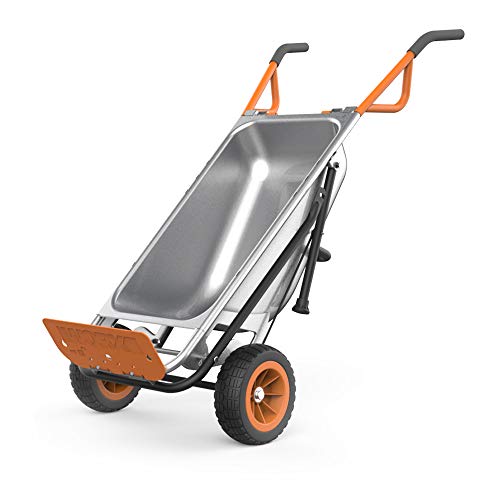
Multi-function yard carts present an innovative alternative to traditional single-wheel barrows by optimizing mechanical leverage. The WORX Wheelbarrow Heavy Duty Dolly, also known as the 8-in-1 Aerocart garden cart, utilizes an all-metal structure with a clever two-wheel placement that changes how loads are balanced. Engineered with a Turbo Lift design, its geometry makes moving a 200-pound payload feel similar to lifting merely 17 pounds. With a heavy-duty load rating capable of handling up to 300 pounds, its compact tub accommodates roughly 40 to 50 round-point shovel loads of standard garden soil.
Two-wheel architectures provide distinct stability advantages over single-wheel barrows when navigating across rutted yards and uneven lawns. Traditional single-wheel units require continuous core stabilization to prevent the tub from tipping sideways when fully loaded. Dual flat-free tires, like those equipped on the WORX Aerocart, eliminate the threat of sudden punctures while keeping the load stable during loading and transit. Dual support legs stabilize the platform as each shovelful lands, preventing the rocking motion that often spills dirt from single-wheel units.
Ergonomics and Biomechanics: Safe Lifting Form and Pacing
Manual excavation places repetitive mechanical stress on the lumbar spine, shoulders, and wrist joints. A single shovel load of damp soil weighs between 10 and 18 pounds depending on moisture content and blade profile. Moving 100 shovels into a wheelbarrow means lifting well over a thousand pounds of dirt in a single loading cycle. Bending from the waist with straight legs concentrates destructive shear forces directly onto the lower lumbar discs, creating severe fatigue.
Proper shoveling technique relies on a stable athletic stance and a controlled hip-hinge movement. Keep your feet shoulder-width apart, bend your knees, and keep the shovel blade close to your center of gravity during the lift. One hand should grip the handle near the socket collar to act as the primary lifting fulcrum, while the other guides the end grip. Avoid twisting your torso while lifting a loaded blade, and instead pivot your entire body toward the cart before depositing the soil.
Pacing your work rhythm and choosing the right handle configuration significantly reduces systemic fatigue. Straight long handles measuring 48 to 54 inches provide excellent reach and allow taller operators to stand more upright during ground-level scooping. Shorter 27 to 30-inch shafts equipped with D-shaped end grips offer superior wrist control and stability when tipping loads into high-sided wheelbarrows. Taking regular micro-breaks to stretch and hydrate prevents the gradual breakdown of proper lifting form over long work sessions.
Practical Tips for Maximizing Efficiency and Preventing Spills
Positioning your equipment strategically before digging begins cuts wasted motion and saves valuable physical energy. Place the wheelbarrow as close to the excavation pile as safety permits, keeping the front wheel oriented in your planned travel direction. Positioning the cart at a 45-degree angle to the material pile minimizes the pivot radius required for each shovel swing. Stepping across small distances while carrying a heavy blade wastes energy and increases the risk of tripping over yard debris.
Distributing the weight correctly within the tub ensures smooth handling once the cart is rolling. Always deposit the first dozen shovel loads directly over or slightly in front of the wheel axle. Placing excessive weight near the rear handles forces your arms and lower back to carry the load rather than letting the tire bear the burden. Stacking material symmetrically from front to back creates a balanced payload that tracks straight across uneven turf without tipping.
Always verify your operating environment before beginning any heavy digging or material hauling project. Calling local utility locating services by dialing 811 protects buried electrical, gas, and communications conduits from accidental shovel strikes. Wear sturdy leather work boots with defined heel treads to maintain traction when pushing loaded carts on damp ground. Heavy-duty work gloves protect your palms from blisters and cushion the impact shock transmitted through wooden or fiberglass tool handles.
Tool Maintenance, Equipment Care, and Practical Conclusions
Maintaining your digging tools and hauling equipment in peak condition extends their operational lifespan by many years. After completing a project, scrape away dried soil residues and wash the shovel blade thoroughly before storage. Sharpening the cutting edge with a standard hand-held mill file restores an efficient 45-degree single-bevel profile that cuts cleanly through tough ground. Treat natural ash wood handles with periodic coats of boiled linseed oil to prevent drying, cracking, and splintering under tough outdoor conditions.
Ultimately, knowing how many shovel loads fill a wheelbarrow helps you balance project timelines, equipment load ratings, and personal endurance. A standard contractor tub takes around 90 to 120 round-point scoops or 50 transfer scoops, while compact carts require roughly 40 to 50 controlled loads. Choosing the proper blade profile, respecting material density limits, and practicing sound lifting ergonomics keeps yard work both efficient and safe. Matching your shoveling rhythm to the structural capacity of your hauling cart ensures long-term success on every outdoor project.
About the author
Tony Flanders is an experienced astronomy writer and observer with a background in mathematics, technical research, and science communication. His extensive observing experience includes exploring deep-sky objects through different telescope configurations. He specializes in making complex astronomical concepts accessible to beginners and experienced observers alike.