
Top Best Bandsaw Blade Brand of 2026 for Workshop Cuts
Selecting the best bandsaw blade brand helps eliminate cut drift in October 2026. Review top picks for stationary and portable band saws.
 By Phil Harrington
Updated October 2, 2026
By Phil Harrington
Updated October 2, 2026

Blade drift ruining expensive hardwood stock often traces back to dull teeth, improper tooth geometry, or weak blade welds. A dull bandsaw blade forces you to push workpieces harder against the rip fence, which bogs down the motor and creates wavy cuts. Selecting the best bandsaw blade brand can transform how your saw handles resawing thick lumber or slicing tight scroll curves. Whether you run a stationary cabinet saw or a compact portable unit, high-grade steel makes an immediate difference in tracking stability. Many woodworkers pair these sharp cutting setups with a dedicated saw for cutting planks of wood to speed up initial stock breakdown.
Careful analysis of manufacturer specifications, alloy compositions, and user feedback highlights major performance differences across leading toolmakers. Carbon steel bands work reliably for general woodworking and tight curves, while cobalt and bi-metal blends deliver the heat resistance required for heavy metal fabrication. If you frequently trim structural stock, comparing blade profiles alongside specialized cold cut metal chopsaws helps you match the right tool to the task. Quality bands ensure your saw runs cooler, holds tension longer, and leaves a remarkably clean edge across every project.
| Award | Product | TGH Score About TGH ScoreThe TGH Score is our own rating from 0 to 10, based on performance, design and build, ease of use, and value. It reflects independent research and is never influenced by manufacturers, retailers, or affiliate commissions. Learn more › | |
|---|---|---|---|
| Best Overall |
POWERTEC 93-1/2 Inch Bandsaw Blades Assortment
|
9.2/10 | Buy |
| Best Budget |
 FOXBC 44-7/8-inch Bandsaw Blades 14/18 TPI
|
8.8/10 | Buy |
| Best Value |
POWERTEC 62 Inch Bandsaw Blades Assortment
|
8.6/10 | Buy |
 DEWALT Portable Band Saw Blade, 32-7/8-Inch
|
8.3/10 | Buy | |
 FOXBC 44-7/8 Inch Bandsaw Blades 10/14 TPI
|
8.1/10 | Buy | |
| Best Premium |
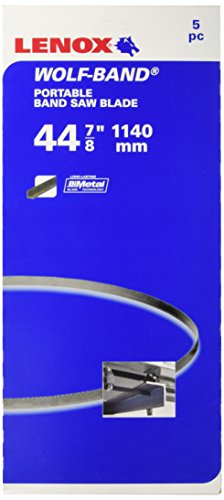 LENOX Tools Portable Band Saw Blades
|
7.8/10 | Buy |
Frequently Asked Questions
What teeth per inch works best for woodworking bandsaws?
Lower tooth counts like 6 TPI work best for thick resawing, while higher ratings around 14 TPI excel at tight curves. A coarse 6 TPI blade features deep gullets that clear sawdust rapidly to prevent motor bogging in dense hardwoods. Higher TPI configurations yield smoother edges on thin lumber and plastics. Selecting the proper tooth pitch for your Best Bandsaw Blade Brand prevents premature heat buildup.
How do carbon steel and bi-metal bandsaw blades compare?
Bi-metal blades offer superior heat resistance and tooth longevity compared to standard carbon steel bands. Carbon steel flexes easily around smaller wheels, making it practical and affordable for general wood carving. Bi-metal options combine an alloy steel backer with high-speed steel teeth, which withstands tough metal fabrication. Woodworkers who also maintain a portable table saw for cabinet making often rely on tough bi-metal bands for cutting through abrasive composite boards.
Why does a bandsaw blade drift during straight cuts?
Blade drift is typically caused by uneven tooth wear, incorrect blade tension, or misaligned guide bearings. When teeth on one side dull faster, the band naturally wanders toward the sharper side under feed pressure. Insufficient tension also allows the blade body to deflect inside the cut. Proper alignment of guide blocks and accurate tracking across crowned wheels keeps your rip cuts parallel to the fence.
Can a wood-cutting bandsaw use metal-cutting blades?
Yes, but standard wood bandsaws run at blade speeds too fast for cutting dense steel. Wood saws usually operate above 2,000 surface feet per minute, which quickly burns teeth upon contacting ferrous metals. Thin non-ferrous metals like brass or aluminum can be cut with fine-tooth blades at modest feed rates. For structural steel, a dedicated portable bandsaw running below 300 surface feet per minute remains the safest choice.
When should you replace a bandsaw blade?
A blade requires replacement when feed resistance rises sharply, cut lines show burn marks, or teeth lose their set. Forcing dull stock against the thrust bearings strains your motor and risks snapping the band. Inspecting the weld line for micro-cracks or listening for rhythmic thumps during rotation will tell you when a blade has reached its limit. Swapping in a fresh replacement from a dependable Best Bandsaw Blade Brand restores peak cutting performance in 2026.
About the author
Phil Harrington is an astronomy educator, author, and experienced optical equipment reviewer with decades of experience exploring the night sky. He has written extensively about telescopes, binoculars, and astronomical observation, combining technical knowledge with practical guidance that helps astronomy enthusiasts understand and select suitable observing equipment.