
Best Mitering Bandsaw of 2026 for Precision Metal Cuts
Clean miter cuts require rigid frames. Check top Best Mitering Bandsaw options for October 2026 with swivel heads, smooth downfeed, and dependable motor torque.
 By Andrew McKean
Updated October 2, 2026
By Andrew McKean
Updated October 2, 2026

Crooked angle cuts on structural tubing quickly waste expensive raw metal and stall workshop fabrication schedules. Swiveling heavy steel stock inside a traditional stationary vise takes tremendous floor clearance and invites severe misalignment. Selecting the best mitering bandsaw solves this bottleneck because a dedicated swivel head turns the cutting bow instead of forcing you to pivot long workpieces. Unlike standard cold cut metal chopsaws that leave burrs and generate intense sparks, a rigid horizontal bandsaw delivers quiet operation, minimal kerf loss, and square joints ready for direct welding.
Careful analysis of manufacturer specifications, motor torque curves, and real shop feedback reveals that frame rigidity and hydraulic downfeed control dictate cut quality. Premium models pair cast iron bows with heavy-duty worm gear transmissions to eliminate cut chatter on dense round stock. Features like built-in flood coolant systems, carbide guide blocks, and variable-speed pulleys keep teeth sharp through tough stainless steel and thick structural channels. Investing in a reliable swiveling bandsaw streamlines repetitive angle slicing while protecting your blades from premature tooth stripping.
| Award | Product | TGH Score About TGH ScoreThe TGH Score is our own rating from 0 to 10, based on performance, design and build, ease of use, and value. It reflects independent research and is never influenced by manufacturers, retailers, or affiliate commissions. Learn more › | |
|---|---|---|---|
| Best Overall |
JET 5" x 6" Mitering Variable-Speed Horizontal
|
9.2/10 | Buy |
| Best Budget |
 Mitering Band Saw, 10 x 7.9
|
8.8/10 | Buy |
| Best Value |
 JET 10" x 16" Metal Cutting Horizontal Band Saw
|
9.2/10 | Buy |
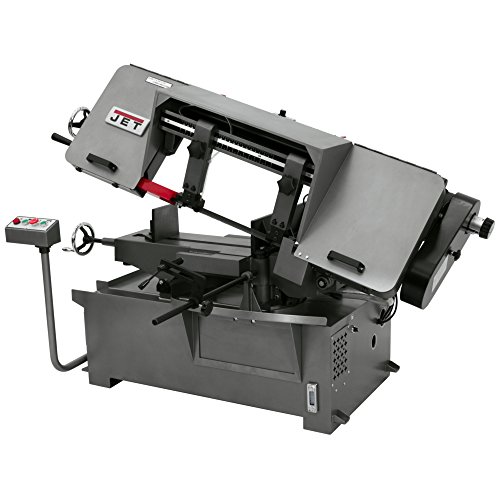 JET 10" x 16" Horizontal Mitering Bandsaw
|
8.0/10 | Buy | |
| Best Premium |
 JET 10" x 14" Metal Cutting Horizontal Mitering
|
9.2/10 | Buy |
 JET 7" x 10-1/2" Metal Cutting Mitering
|
9.1/10 | Buy |
Frequently Asked Questions About Mitering Bandsaws
What is the main advantage of a swivel head over a swivel vise?
A swivel head bandsaw rotates the cutting bow while keeping the stock stationary against the backstop. This design eliminates the need to swing long, cumbersome metal pipes across your shop floor. It saves floor space and keeps cut angle alignment consistent between consecutive cuts. Fabricators working in compact spaces benefit greatly from this swiveling head geometry.
Why is a hydraulic downfeed cylinder necessary on a mitering metal bandsaw?
A hydraulic downfeed cylinder provides smooth, hands-free descent that prevents the blade teeth from slamming into the workpiece. Regulating the drop rate maintains uniform cutting pressure, which stops teeth from stripping on thin-wall tubing. Counterbalance springs paired with adjustable hydraulic valves also ensure straight kerfs through dense solids. This controlled descent significantly extends blade lifespan across daily shop cutting cycles.
Can a mitering bandsaw run on standard 115V household power?
Yes, smaller utility units up to 1.5 horsepower readily operate on standard 115V single-phase electrical circuits. Larger industrial mitering machines with 2 or 3 horsepower motors generally require 230V or 460V three-phase connections to deliver maximum torque. Home garage owners should verify motor amp draw and voltage requirements prior to purchase. Selecting a dual-voltage motor allows you to wire for 115V now and upgrade to 230V later.
How important is a flood coolant system when cutting metal at an angle?
A built-in flood coolant system is crucial for dissipating friction heat and clearing chips during angle cuts. Miter cuts create an elongated cutting path, exposing blade teeth to prolonged contact with hot steel. Pumping fluid directly through guide blocks flushes away metal swarf and prevents premature dulling. Cutting dry often results in heat-hardened material surfaces and scorched blade welds.
What blade tooth pitch works best for mitering structural tubing?
A variable pitch blade such as 10/14 TPI delivers the cleanest results on structural tubing and angle iron. Maintaining at least three teeth in contact with the material wall prevents tooth snagging and blade chatter. Much like aligning rip cuts on a portable table saw for cabinet making, selecting the proper blade pitch ensures clean, chatter-free cuts. Coarser tooth pitches like 6/10 TPI suit solid round bar stock better by providing larger gullets for chip clearing.
How does a Best Mitering Bandsaw maintain accurate angle cuts over time?
Heavy cast iron construction and adjustable carbide guide bearings keep the blade true during deep cuts. Setting positive angle stops at 45 and 90 degrees eliminates guesswork during rapid setups. Regular inspection of blade tension handwheels and guide roller alignments prevents blade wandering. Checking the swivel lock clamping lever ensures the bow never drifts under heavy downward cutting pressure.
About the author
Andrew McKean is an experienced outdoor journalist and optics specialist with extensive experience evaluating binoculars, spotting scopes, and other outdoor optical equipment. His work combines practical field testing with detailed technical analysis, helping readers understand optical performance, durability, and the features that matter when comparing equipment.